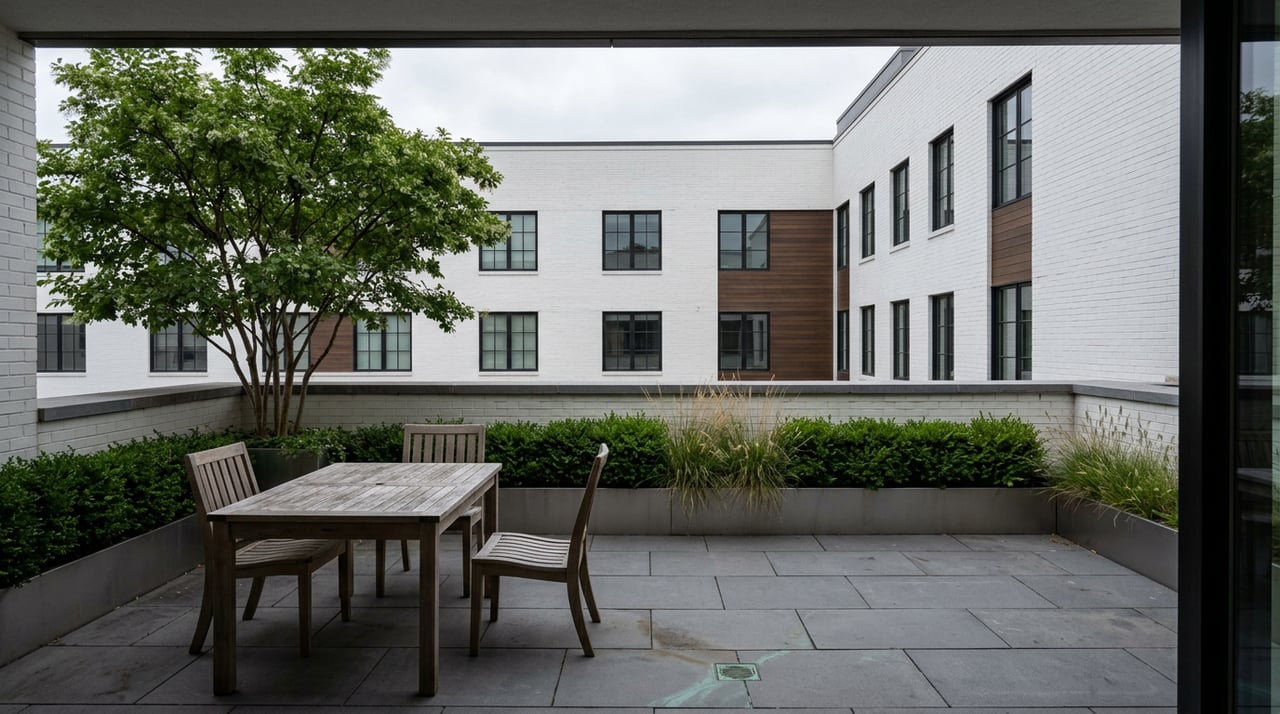
In January 2013, the Tennessee Court of Appeals issued a ruling in Preserve at Forrest Crossing Townhome Association, Inc. v. Marsha DeVaughn that most Nashville STR buyers have never read — but probably should. A townhome owner and her tenant challenged an amendment adopted by the owner's townhome association prohibiting her from leasing her unit to a third party. She had purchased her unit before there were any restrictions on leasing individual units. The amendment was adopted in accordance with the Horizontal Property Act and the documents governing the units where she lived. The trial court granted the association's motion for summary judgment, enjoining the owner from renting her townhome and requiring the tenant to vacate. On appeal, the court concluded the amendment was enforceable and affirmed.
That community — The Preserve at Forrest Crossing, a townhome development situated on 17.95 acres in Williamson County consisting of 53 residential units configured in 11 four-unit buildings and 3 three-unit buildings — became the legal blueprint that other Tennessee HOAs would cite when they wanted to do the same thing. The ruling did not just affect one owner. It set a precedent that an HOA can amend its CC&Rs to restrict rentals, and that amendment can apply to owners who bought before the language ever existed.
Take that apart carefully, because this is exactly the risk that sits inside dozens of Nashville-area buildings and townhome communities right now. A Metro permit is not a shield. Zoning approval is not a shield. The HOA layer operates independently of both — and under Tennessee law, it wins.
The Two-Layer Problem That Traps Nashville STR Buyers
Most buyers searching for a Nashville short-term rental investment understand, at least loosely, that Metro Nashville restricts where you can operate. Nashville has some of the strictest rules in the state, especially for non-owner-occupied rentals in residential zones. Owner-occupied rentals are widely allowed; non-owner-occupied ones are only permitted in select non-residential districts. That framework is well-documented and increasingly understood by serious investors.
What gets people into trouble is the second layer. Beyond the government regulations, many properties are also subject to private restrictions — HOA covenants and bylaws, condominium declarations, and deed restrictions — that can independently prohibit or limit short-term rental use regardless of whether the Metro government would issue a permit. The key phrase is "regardless of whether." Metro saying yes does not mean the building says yes. The HOA layer is independent of municipal zoning.
Tennessee's own Short-Term Rental Unit Act, which took effect May 17, 2018, makes this explicit. Under TCA 13-7-605, the Act does not preempt private restrictions. HOAs, condos, and co-ops can ban or restrict STRs regardless of any Metro permit. The state law that protects STR operators from arbitrary municipal crackdowns offers zero protection when the restriction comes from the HOA itself. That is not a loophole. That is the design.
What Happened at The Preserve — Layer by Layer
The Forrest Crossing case is worth examining in detail because it illustrates exactly how this plays out. Forrest Crossing does not permit renting, either short-term or long-term, which helps maintain the owner-occupant character of the community. That outcome did not exist when the development opened. Pulte Homes Tennessee L.P. received approval of plans from the City of Franklin on August 22, 2001. Buyers who purchased in the early years of the community had no rental restriction in their deed. Then the HOA voted to add one.
Another Tennessee HOA later relied on the DeVaughn case to justify an effort to amend its own existing restrictive covenants — covenants drafted in 1984 but not recorded until 2000 — in order to ban short-term rentals. The legal argument was that under the Horizontal Property Act, a properly voted amendment to a condominium or townhome association's governing documents is enforceable against all unit owners, including those who purchased before the amendment. The unit owner appealed, arguing the amendments could not be applied retroactively since they were not in the deed at the time she purchased. The Tennessee Court of Appeals affirmed, basing its decision nearly exclusively on the fact that The Preserve was a condominium complex and the Horizontal Property Act applied.
Sit with that for a moment. You buy a townhome. No rental restrictions in the deed. A few years pass. The HOA votes to ban all rentals. You are now barred from renting your own property — short-term or otherwise — and a Tennessee court says that is legal. CC&R amendments commonly require approval from 50% to 75% of owners, depending on the governing documents and state law. Some HOAs allow existing hosts to continue temporarily, often for 6 to 12 months, but grandfathering is not always required. Whether you get a wind-down period or an immediate injunction depends entirely on how the amendment was written and whether you have the stomach for litigation.
Nashville's Downtown Condo Buildings: The Rule Is Already Written
For buyers targeting downtown Nashville specifically, this is not a hypothetical risk. No downtown Nashville high-rise condo buildings allow short-term rentals. Buildings like Viridian, ICON, and Encore restrict owners to minimum 12-month leases and typically limit rental permits to just approximately 20% of total units. While you may see some Airbnb listings in downtown high-rises, these are usually master-leased apartment units, not individually owned condos.
The investors who get burned here are the ones who see an Airbnb listing at a specific building address, assume the building allows STRs, and write an offer on a resale unit without reading the condo declaration. The listing they saw was a managed apartment floor. The unit they are buying is individually owned — and covered by completely different rules. Those rules may say 30-day minimum lease. They may say 12-month minimum. Either way, that Metro permit application goes nowhere.
By default, most HOA bylaws require any tenants to sign leases for a minimum of six to twelve months. This automatically eliminates short-term rental possibilities unless the HOA specifically allows it. "Specifically allows it" is doing real work in that sentence. Silence is not permission. The absence of a written STR ban does not mean the HOA has blessed your Airbnb. It means they may not have gotten around to banning it yet.
The HOA Amendment Risk Is Ongoing, Not Just at Purchase
Here is the piece most buyers miss entirely: HOA short-term rental restrictions are not just a pre-closing due diligence issue. They are an ongoing ownership risk. Homeowners association laws in Tennessee may permit associations to impose rental restrictions, but such rules must be clearly stated in the association's covenants and bylaws and must comply with state and federal laws. A compliant amendment process does not require your individual consent. It requires a vote of the membership — which may include a majority of owner-occupants who have no interest in seeing their building treated as a hotel.
This is what makes the Forrest Crossing precedent so pointed for Nashville investors in 2026. If you close on a unit today in a building where the CC&Rs are silent on STRs, you are betting that the composition of owners and the building's board will stay aligned with STR use indefinitely. HOAs may verify STR activity through listing platforms, owner registrations, neighbor complaints, guest reports, parking records, and public permit databases. Enforcement is more sophisticated than it was five years ago. Boards that once looked the other way have learned to look more carefully.
The risk compounds because of how Metro Nashville's permit rules interact with this. Existing NOO permit holders in restricted zones may renew, but the permit is not transferable if the property is sold or transferred. On sale it is gone for good. So the investor who paid a premium for a "permitted STR" with a grandfathered residential-zone NOO permit already faces a resale problem — the next buyer cannot get that permit back. Layer an HOA amendment on top of that, and you have two structural headwinds hitting simultaneously.
What the Due Diligence Actually Looks Like
Buying an STR in Nashville — or any property you intend to rent short-term — without completing a full HOA review before closing is not aggressive investing. It is incomplete underwriting. The documents that control your STR viability are not always obvious. You need to review the Declaration of Covenants, Conditions, and Restrictions, the bylaws, any rules and regulations adopted by the board, and any recorded amendments. Homeowners can access their HOA's rules and regulations by requesting copies of the governing documents, which typically include the covenants, conditions, and restrictions.
Properties have been purchased with the expectation of STR use only for the buyer to discover post-closing that the HOA prohibits it, or that a recent permit-distance restriction blocked the property, or that an overlay district restriction applies. That is not a Nashville rumor. It is documented enough that attorneys in this market now flag it explicitly as the primary pre-purchase risk for investment buyers. An attorney experienced in this area can help you interpret these documents, evaluate whether a property actually qualifies for the type of permit you need, and identify risks before you close on a purchase.
On the Metro permit side, the mechanics are straightforward but the timing matters. Nashville STR permit applications currently take 30 to 90 days from submission to issuance. Operating before the new permit issues is unpermitted operation. Renting the property between closing and new-permit issuance is unpermitted operation regardless of the prior owner's permit history. If you list on Airbnb before your permit clears, you become ineligible to apply for one for a full year. That is a self-inflicted wound that costs twelve months of operating income.
For investors evaluating Nashville STR deals across Germantown, The Nations, SoBro, or East Nashville, the full Costigan Group STR advisory framework includes HOA verification as a non-negotiable step before any offer is submitted. Not after inspection. Before the offer.
The Valuation Consequence Nobody Warns You About
When an HOA votes to ban STRs — whether in a building you already own or one you are considering — it does not just change your operating rights. It changes your exit pricing. The property's STR business value goes to zero at the moment of sale when a non-transferable permit dies on the transaction. An HOA ban accelerates that dynamic and removes even the owner-occupied STR fallback in many cases.
The premium varies by zoning certainty: a property in the 29 NOOSTR-eligible districts commands a different premium than a grandfathered residential-zone NOOSTR with a non-transferable permit. Drop a binding HOA restriction into either scenario and you are now pricing the unit as a straight residential sale — no STR income multiplier, no investor pool bidding it up. The buyer set shrinks. The cap rate discipline disappears. You are selling a square footage and a location.
That is not a theoretical outcome for Nashville owners. It is the direct consequence of what happened to owners inside Forrest Crossing when the amendment passed. The investors among them went from operating rental income properties to owning units with a recorded restriction against rental use — with no recourse available under Tennessee appellate law. If you want to understand how Nashville STR investing fits into a broader investment portfolio, the neighborhood context shapes every underwriting decision about where that risk is higher or lower.
Related reading
- Nashville Short-Term Rental Investment
- Nashville STR Permit Guide: What Buyers Must Verify Before Going Under Contract
- STR Permit Transferability Tennessee: What Happens to Your Nashville Permit When Ownership Changes
Frequently Asked Questions
Can a Nashville HOA ban short-term rentals even if Metro has issued a permit?
Yes. Under TCA 13-7-605 of the Tennessee Short-Term Rental Unit Act, the Act does not preempt private restrictions. HOAs, condos, and co-ops can ban or restrict STRs regardless of any Metro permit. HOA and condo bylaws can be stricter than Metro and frequently ban STRs outright. A Metro permit gives you legal authorization from the city; it does not override the private contractual restrictions in your deed and governing documents.
Can an HOA change its rules to ban STRs after I've already bought and started operating?
Yes, under Tennessee law. Tennessee courts have upheld amendments adopted by townhome and condo associations that prohibited owners from leasing their units — even when the owner purchased before there were any restrictions on leasing. The Tennessee Court of Appeals concluded such amendments are enforceable. Some HOAs allow existing hosts to continue temporarily, often for 6 to 12 months, but grandfathering is not always required. Review the amendment process in your specific CC&Rs and consult a Tennessee real estate attorney before assuming you are protected.
What documents should I request to check HOA short-term rental rules before buying in Nashville?
Request the full governing document package: the Declaration of Covenants, Conditions, and Restrictions (CC&Rs), the bylaws, any board-adopted rules and regulations, and all recorded amendments. For condos, review HOA bylaws, rental rules, minimum stay requirements, and any special resolutions about short-term rentals. Ask specifically for the meeting minutes from the past two years — board discussions about STR policy often surface before a formal amendment is filed.
Do Nashville HOA rules apply differently to owner-occupied STRs versus investor-owned units?
Potentially yes, depending on how the governing documents are written. Some boards may require a formal process to allow rentals, and there might be restrictions on the number of days a property can be rented or specific areas of the property that can be used by guests. An HOA can craft language that permits owner-occupied short-term hosting while banning non-owner-occupied rentals, or it can ban all rentals under 30 days with no distinction. What the document actually says controls — not what the listing agent or seller represents verbally.
What happens to an NOO STR permit in Nashville when a property sells?
Existing NOO permits in restricted residential zones may renew, but they are non-transferable. When the property sells, the permit dies with the transaction. This creates a shrinking pool of grandfathered NOO permits in residential areas. The buyer cannot obtain a new NOO permit in those zones, which means a property selling with an active grandfathered residential NOO permit is effectively selling its STR business value to no one — that income stream ends at closing for any buyer who doesn't move in.
Are there Nashville condo buildings where STRs are actually permitted by the HOA?
Yes, but they are purpose-built for it and require both the right zoning and explicit HOA permission. There are two main paths: STR-built condo buildings where the zoning and the HOA were designed for nightly rental, and fee-simple homes and townhomes in eligible districts. These buildings were structured from the ground up with STR-permissive governing documents. No downtown high-rise condo building in Nashville allows short-term rentals — buildings like Viridian, ICON, and Encore restrict owners to minimum 12-month leases. If a building was not designed for STR use, assume it prohibits it until you have written confirmation otherwise. For a full breakdown of how The Costigan Group underwrites Nashville STR investments — including HOA review — see our short-term rental advisory page.
What are the fines for operating an STR in Nashville without a valid permit?
The permit fee is $313. Operating without a valid permit carries fines of $50 per day for the first violation, escalating to $500 per day for repeat offenses. Properties with multiple violations face permit revocation and a two-year prohibition on obtaining a new permit. If you list before your permit is in hand, you become ineligible to apply for one for a full year. These are not soft enforcement positions — Metro's STR enforcement team uses public listing platforms to identify unpermitted operators.
About The Costigan Group
Jack Costigan is the founder of The Costigan Group at Compass in Nashville, where his team has closed more than $100 million in real estate across Greater Nashville and Middle Tennessee. Specializing in luxury advisory, investment, and short-term rental real estate, Jack is known for a data-driven approach that helps buyers, sellers, and investors understand the numbers, the neighborhood, and the long-term value before making a decision. Featured in Apple News as one of Nashville's most sought-after short-term rental advisors, Jack pairs deep local expertise with modern marketing and a strategy-first approach to real estate. Learn more at thecostigangroup.com.