Get The Short Term Rental Calculator
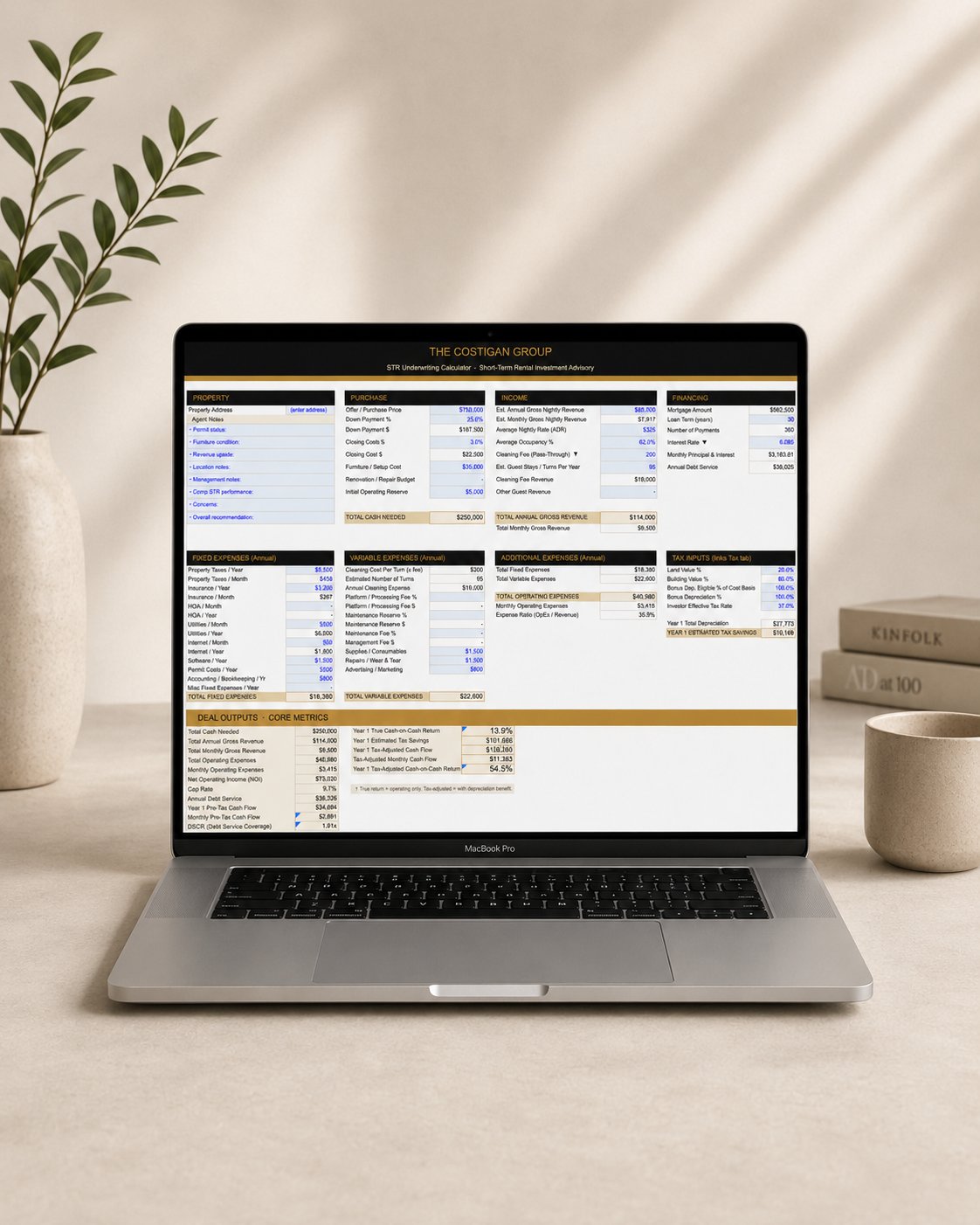
Download The Costigan Group’s STR underwriting calculator to estimate income, expenses, cash flow, projected returns, and potential tax benefits before buying a short-term rental.
Buy, sell, and evaluate Nashville STR properties with a team that understands permits, zoning, revenue, furnishing, and long-term exit strategy.

Nashville short-term rentals are not traditional residential real estate. They are operating businesses tied to zoning, permits, revenue, furnishing, management, financing, guest demand, and long-term resale value. That is why Jack Costigan and The Costigan Group built a dedicated short-term rental advisory platform around this niche.
Jack Costigan specializes in Nashville Airbnb and short-term rental real estate, including NOO STRs, revenue-producing properties, MIPA opportunities, LLC transfers, underwriting, furnishing strategy, and STR exit planning. As the founder of The Costigan Group at Compass and the founder / lead of Compass’s Short-Term Rental Division, Jack has built a process designed to help buyers, sellers, and investors understand the full picture before they make a decision.
Recognized by Apple News for his work in Nashville short-term rental real estate, Jack brings a rare combination of local market knowledge, regulatory awareness, underwriting experience, and real transaction experience to one of the city’s most complex real estate categories.
Our advisory approach goes beyond finding properties. We help clients evaluate zoning, permit eligibility, ownership structure, projected revenue, operating expenses, furnishing costs, management options, resale value, and long-term investment strategy so they can make informed decisions before buying or selling.
Download The Costigan Group’s STR underwriting calculator to estimate income, expenses, cash flow, projected returns, and potential tax benefits before buying a short-term rental.

Nashville remains one of the country's most active short-term rental markets, but identifying the right investment requires far more than finding a property in a popular neighborhood. Zoning, permit eligibility, ownership structure, projected revenue, operating expenses, financing, and long-term resale value all play a critical role in determining whether an STR will actually perform.
The Costigan Group specializes in helping buyers, sellers, and investors navigate Nashville's short-term rental market with a data-driven approach. From NOO-eligible properties and existing revenue-producing STRs to MIPA opportunities and development projects, our team helps clients evaluate opportunities with a focus on both risk and return.
Whether you're purchasing your first STR, expanding a portfolio, or preparing a property for sale, we provide the market knowledge, underwriting guidance, and local expertise needed to make informed investment decisions.
Thinking about buying, selling, or investing in a Nashville STR? Start with the guide our team uses to help clients understand zoning, permits, neighborhoods, returns, and common mistakes before they buy.

Nashville has evolved from a niche short-term rental market into one of the country's most closely watched investment destinations. Strong tourism, a growing convention calendar, corporate travel, and a nationally recognized entertainment economy continue to support year-round demand across many areas of the city.
However, successful STR investing in Nashville is no longer as simple as purchasing a property and listing it online. Today's market requires a thorough understanding of zoning regulations, permit eligibility, financing options, operating costs, neighborhood performance, and long-term exit strategy.
Investors evaluating Nashville short-term rentals should consider:
While Nashville continues to offer attractive opportunities, the highest-performing investments are typically those acquired with a clear understanding of both the numbers and the regulations. A property that appears profitable on paper can quickly become problematic if permit restrictions, financing limitations, or operational realities are overlooked.
Whether you're purchasing your first short-term rental, expanding a portfolio, or evaluating an existing STR asset, understanding these fundamentals is essential before making an investment decision.

Yes — Airbnb and short-term rentals are legal in Nashville. However, not every property qualifies, and one of the most expensive mistakes investors make is assuming a home can be used as a short-term rental simply because similar listings exist nearby.
Unlike many markets, Nashville's short-term rental regulations depend on factors including zoning, permit eligibility, ownership structure, and intended use of the property. Before purchasing an Airbnb investment property, buyers should verify that the property meets all local requirements and aligns with their long-term investment goals.
Nashville short-term rental eligibility is typically influenced by:
For investors, understanding these regulations before closing is critical. A property that appears attractive based on projected revenue can become a poor investment if permit restrictions limit its ability to operate as a short-term rental.
Whether you're purchasing your first Airbnb property or expanding an existing portfolio, permit and zoning analysis should be one of the first steps in the evaluation process—not the last.

Nashville recognizes multiple categories of short-term rental permits, each with different rules, limitations, and investment implications.
Owner-occupied permits generally require the owner to reside at the property as a primary residence or on the same lot. These permits are more common in residential areas and can provide homeowners with an opportunity to generate supplemental income while maintaining occupancy requirements.
While owner-occupied permits offer flexibility, they are typically not designed for investors seeking a purely income-producing Airbnb asset.
Non-owner occupied permits function more like traditional investment properties. These permits allow owners to operate short-term rentals without living on-site but are significantly more restrictive and subject to specific zoning requirements.
Many investors specifically seek non-owner occupied opportunities because they provide the greatest operational flexibility. However, permit availability, zoning restrictions, and transfer considerations make due diligence essential before purchasing.
Understanding the distinction between owner-occupied and non-owner occupied permits is one of the most important factors when evaluating revenue potential, financing options, long-term cash flow, and future resale value.

The best Nashville Airbnb investments are usually not chosen by neighborhood name alone. Strong short-term rental performance is driven by a combination of guest demand, zoning, permit eligibility, purchase price, design, bedroom count, parking, walkability, and resale value.
High-performing Nashville STR locations typically offer:
Popular areas for Nashville Airbnb and short-term rental investors include Downtown, SoBro, Germantown, East Nashville, The Nations, Wedgewood-Houston, and select pockets near major development corridors.
That said, neighborhood alone does not make a property a good STR. A great-looking Airbnb in the wrong zoning can become a major problem, while a less obvious property with cleaner eligibility, stronger numbers, and better operating flexibility may be the smarter investment.
The best approach is to evaluate the neighborhood and the property together.

Zoning is one of the most important parts of buying an Airbnb or short-term rental in Nashville. A property can look perfect online, project strong revenue, and still fail as an investment if it does not qualify for the correct STR permit.
For non-owner occupied short-term rentals, Metro Nashville currently limits new permits to specific commercial, mixed-use, office, downtown, and certain corridor zoning districts. These include:
MUN, MUN-A, MUL, MUL-A, MUG, MUG-A, MUI, MUI-A, OG, OR20 through OR40-A, ORI, ORI-A, CN, CN-A, CL, CL-A, CS, CS-A, CA, CF, DTC North, DTC South, DTC-West, DTC Central, SCN, SCC, and SCR.
New non-owner occupied STR permits are generally not issued in traditional residential zoning, including AR2A, R, RS, and RM zoning, unless the property has an existing grandfathered permit that remains eligible for renewal. Even then, buyers need to be careful. Existing permits often do not automatically transfer when a property sells or ownership changes.
Properties in NS zoning, as well as some SP or PUD zoning districts, may also have additional restrictions or may not allow the intended STR use. That is why the zoning classification, permit history, ownership structure, and intended use need to be reviewed before a buyer goes under contract or removes contingencies.
This is where many Nashville STR investors get hurt. They assume that because a property has been used as an Airbnb, or because nearby properties appear on Airbnb, the use is automatically legal going forward. That is not always the case.

Short-term rentals can produce stronger revenue than traditional long-term rentals, but gross revenue is only the starting point. The real question is what the property produces after debt service, taxes, insurance, utilities, cleaning, management, maintenance, furnishing, repairs, platform fees, and vacancy.
When evaluating a Nashville Airbnb or STR investment, investors should look beyond projected nightly rates and focus on the true net income of the property.
Key numbers to review include:
Many underperforming STR investments are not bad properties — they are bad assumptions. Overly optimistic revenue projections, underestimated expenses, weak management, or poor financing can turn a good-looking Airbnb into a disappointing investment.
The strongest Nashville STR investments are usually the ones with durable guest demand, realistic underwriting, clean permit eligibility, strong design, and multiple exit options. The goal is not just to chase the highest projected revenue. The goal is to buy a property that makes sense as both a business and a long-term real estate asset.





Three deeper Costigan Group reads that support the advisory on this page.
Answers to the most common questions buyers, sellers, and investors ask about Nashville short-term rentals, Airbnb permits, zoning, ownership structure, and STR investment strategy.
Yes. Airbnb and short-term rentals are legal in Nashville when operated in compliance with Metro regulations. However, not every property qualifies. Eligibility depends on zoning, permit type, ownership structure, intended use, and whether the property is owner-occupied or non-owner occupied. Before purchasing a Nashville Airbnb or STR, buyers should verify that the property can legally operate as intended.
New non-owner occupied STR permits are generally limited to certain commercial, mixed-use, office, downtown, and corridor-based zoning districts. They are generally not issued in traditional residential zoning such as R, RS, RM, or AR2A unless the property has a grandfathered permit that remains eligible for renewal. NS zoning and certain SP or PUD districts may also create additional restrictions. Always verify zoning before writing an offer.
In many cases, STR permits do not automatically transfer when a property sells. This is one of the most important issues to review before buying a revenue-producing Airbnb or short-term rental. Some transactions may involve existing entities, MIPA structures, or grandfathered permit situations, but buyers should never assume the permit survives a sale, deed transfer, or ownership change without proper due diligence.
Owner-occupied STR permits generally require the owner to live at the property as a primary residence or on the same lot. Non-owner occupied STR permits are designed for investment properties where the owner does not live on-site. In Nashville, non-owner occupied STRs are much more restricted and usually require specific zoning. The difference matters because it affects legality, financing, operations, cash flow, and resale value.
Yes. Many Nashville Airbnb and STR investors are based outside Tennessee. However, out-of-state buyers need strong local guidance because zoning, permits, furnishing, management, cleaning, maintenance, and revenue assumptions all affect performance. A hands-off investment is possible, but it requires the right property, proper underwriting, and experienced local operators.
Timing can vary depending on the property, permit type, documentation, inspections, insurance, and Metro review. Buyers should not assume a permit can be obtained immediately after closing. If the investment strategy depends on short-term rental income, the permitting timeline should be discussed before purchasing so the buyer understands potential delays, holding costs, and launch timing.
Revenue varies widely based on location, bedroom count, design, amenities, management, reviews, seasonality, competition, and purchase price. Investors should focus on net income, not just projected gross revenue. Taxes, insurance, utilities, cleaning, management, furnishing, maintenance, platform fees, and debt service can significantly affect returns. A strong Nashville Airbnb investment should be underwritten conservatively before purchase.
Jack Costigan and The Costigan Group specialize in Nashville Airbnb and short-term rental real estate, including NOO STRs, MIPA opportunities, revenue-producing properties, underwriting, furnishing strategy, management coordination, and STR exit planning. Jack is the founder of The Costigan Group at Compass and the founder / lead of Compass’s Short-Term Rental Division, giving clients a more specialized advisory process than a traditional residential real estate search.