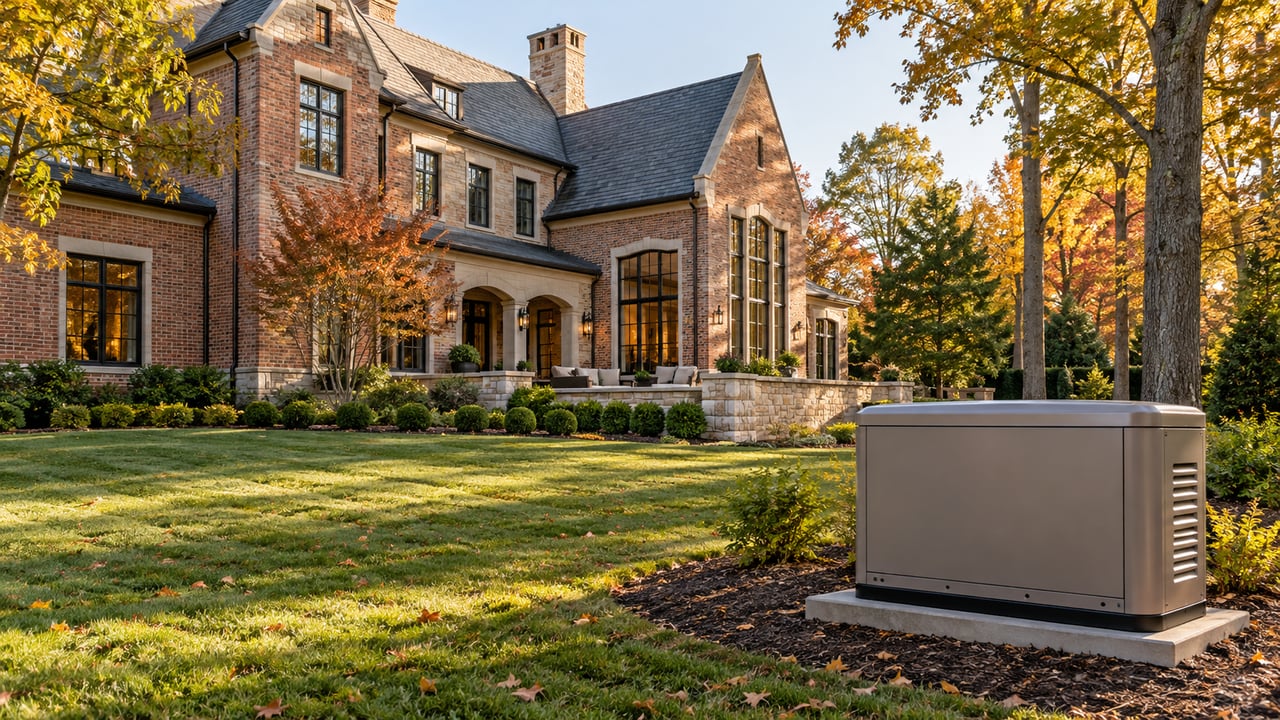
A standby generator at a Nashville luxury home is useful only in relation to the systems it is configured to support. Before treating “whole-house backup” as a confirmed property feature, ask for the installed-equipment record, the supported-load plan and evidence of what a qualified professional actually tested.
A generator starting on schedule answers a different question from the home operating on generator power. The buyer needs to connect the equipment, transfer arrangement, household priorities and test scope. An attractive cabinet beside a well-maintained estate does not supply that evidence.
This review concerns permanently installed standby equipment. The questions below are for the seller, installer and qualified service professional; they are not instructions for operating switches or testing an electrical system yourself.
Identify the installed equipment and its documentation
Request the generator's model and serial identification, available installation and commissioning records, service history and the manual applicable to that unit. Ask the professional to identify the transfer equipment and any load-management components included in the system.
Check whether the documents describe the equipment currently present. A brochure for a newer model, a service invoice for a different serial number or an old proposal for an installation that changed needs clarification. Preserve the source documents rather than summarizing everything as “generator installed.”
Have the installer or appropriate professional explain the applicable installation and inspection documentation. Ask which authority and records apply to the property's actual jurisdiction and work. A Nashville-area address alone does not establish the responsible permitting office or prove that a particular installation was approved.
Distinguish routine exercise from supporting the house
Generac's 2023 owner's manual for its 10–26 kW, 60 Hz air-cooled models makes this distinction explicit. Under “Setting the Exercise Timer” on printed page 19, it explains that the exercise cycle does not transfer loads to the generator unless utility power is lost.
That is a model-specific manufacturer example, not a statement that every generator uses the same exercise program. It shows why a buyer should ask what an observed run actually demonstrates. A scheduled start recorded in an app is not automatically a test of the household loads the buyer expects to use.
Ask a qualified professional to define and perform any proposed examination or test with the owner's authorization and the correct equipment instructions. Get a written scope identifying what was evaluated, under what conditions and what remained outside the test. Keep an explanation of limitations alongside any result.
Build a supported-load list around the home
Start with how you would use this particular house during an outage. List the household systems that matter and ask the professional to identify whether and how the installed arrangement supports them. Keep priorities separate from confirmed capabilities.
Household question | Evidence to request | What remains unresolved without it |
|---|---|---|
Which heating or cooling equipment is supported? | Identified equipment and the professional's explanation of its place in the backup plan | Assuming every zone operates because one system was observed |
Which kitchen, lighting and outlet loads are included? | Supported circuit or equipment schedule checked against the actual home | Assuming the phrase “whole-house” identifies every included load |
Are pumps, gates or other property systems included? | Location-specific identification and confirmed coverage | Missing a separate structure or system outside the reviewed scope |
Are some loads controlled or prioritized? | Explanation of the installed control arrangement and intended operating limits | Assuming every high-demand appliance can operate together |
What did the examination actually cover? | Dated report listing equipment, conditions, observations and exclusions | Treating an engine run as proof of every household function |
A room-by-room wish list is a starting point for the professional review, not a sizing calculation. If an appliance, addition or outbuilding changed after installation, ask whether the supporting records were updated. Do not assume that a generator installed for the previous household's use fits a new owner's plans.
Read the fuel and service plan with the operating record
Ask the service professional to identify the fuel arrangement and explain what documentation is needed to assess it. For a tank-supplied installation, ask what assumptions support any stated runtime and who handles monitoring and replenishment. For any system, keep claimed operating duration tied to the specific conditions being discussed.
Review dated service reports, recorded faults, repairs and outstanding recommendations. Separate “maintenance scheduled” from a completed service record. If the seller supplies an app screenshot, request the underlying explanation of the event rather than interpreting a status symbol as a complete condition assessment.
Ask what service is due next under the applicable manufacturer instructions and the equipment's history. Request a property-specific service proposal if cost is material to the decision. This article assumes no universal Nashville maintenance fee, fuel cost or guaranteed number of backup hours.
Connect findings to a complete proposal
If the review identifies a concern, ask for a scope that explains the affected component, the intended result and any further investigation required. A proposal to service the engine and a proposal to change the supported-load arrangement may answer different questions. Comparing their totals alone will not make them equivalent.
Identify work or access needed outside the visible cabinet, any required approvals, restoration and the evidence expected at completion. Have the appropriate professionals explain those items before treating an allowance as a complete solution. A credit in a purchase negotiation does not establish that the work has occurred.
Keep the physical condition, documented capability and proposed spending separate in the acquisition file. A recently serviced unit may still have an unverified coverage question; a clearly documented coverage plan may still leave a repair outstanding. The file should show both.
Keep this system review alongside the broader Nashville home inspection discussion. Use the actual specialist findings, complete work scope and purchase agreement to decide which questions need further investigation before the transaction proceeds.
Plan the ownership handoff
Ask which service arrangements, monitoring accounts, warranties and records would need attention after the purchase. Confirm any transfer or new-owner requirements with the actual provider or issuer. Do not assume that the seller's subscription, service agreement or warranty automatically becomes the buyer's.
Retain the equipment identification, applicable manuals, supported-load record, dated professional report and contact details for ongoing service. That gives the new owner a useful baseline for later changes, rather than a folder containing only marketing material.
Bring the generator file and any unresolved scope questions to The Costigan Group's Nashville luxury advisory team and your qualified specialists. The Greater Nashville neighborhood resource supports the location search; the equipment review supports the decision on a particular home. Use a property-specific discussion to identify which records still need to be obtained before relying on the backup-power description.
Written by Jack Costigan, The Costigan Group. Manufacturer example checked October 20, 2026; the cited manual is Revision C, dated May 12, 2023. This educational review does not size, test or approve an installation. Cover: an AI-generated illustrative Nashville-area home, not an actual listing or approved equipment-installation detail.