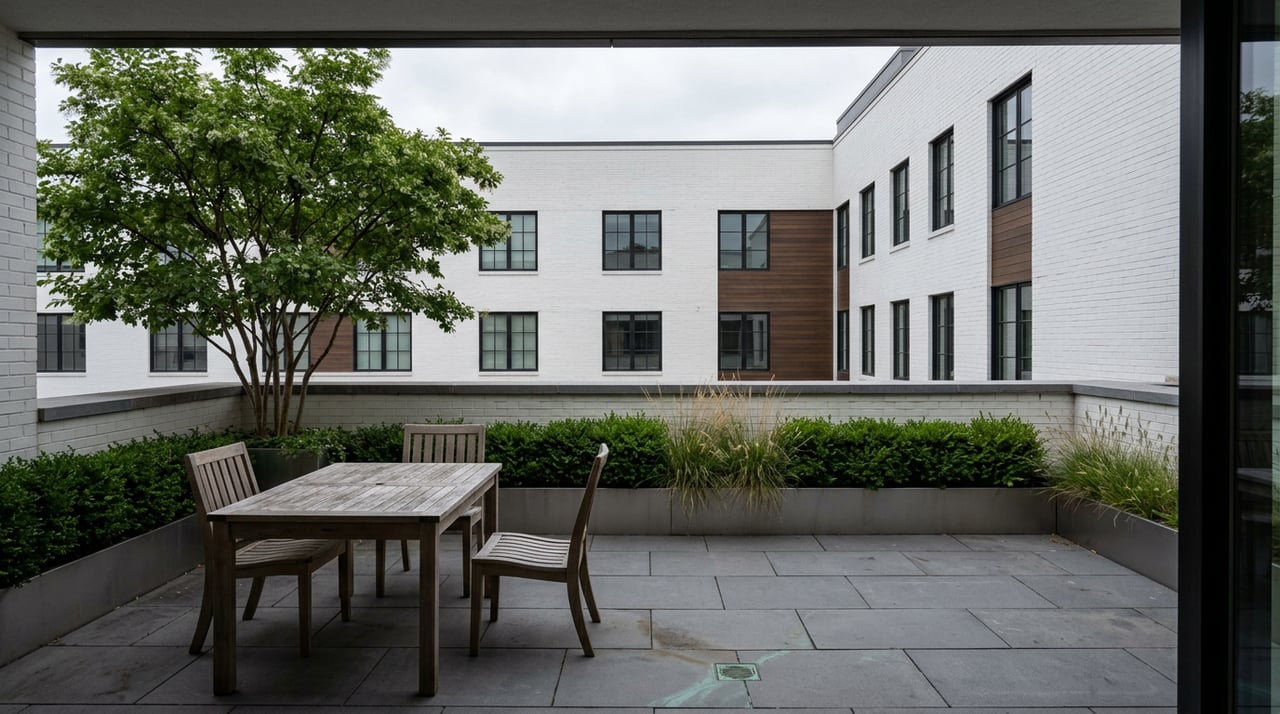
A client came to us wanting to sell their East Nashville short-term rental. Four bedrooms, rooftop deck, permitted non-owner-occupied. The property was generating strong revenue. Their instinct was to price it like the residential comps down the street — because that is what they knew, and because their agent at the time was treating it that way.
That would have cost them six figures.
This is a Nashville STR case study about how we actually approach pricing and positioning for performing short-term rental properties — and why the tools most agents use to price a home are the wrong tools entirely when the asset on the table is a documented income-producing business.
The Mistake Most STR Sellers Make in Nashville
The default in residential real estate is simple: pull the comps, apply price per square foot, adjust for condition. Done. That model works reasonably well when you are pricing a primary residence. It fails badly when you are pricing a performing STR.
Here is why. Buyers in the Nashville STR market underwrite acquisitions as cash-flowing assets, which means documented historical revenue, current bookings calendar, and permit transfer status materially affect the price a serious investor will pay at resale. The difference between selling at "residential property with STR potential" pricing and "performing STR business" pricing is documentation.
Read that again. The documentation is the premium. Not the granite countertops. Not the neighborhood Instagram shots. The income record.
When a seller prices their permitted, high-performing STR against the residential comps without building and presenting a verified revenue package, they are essentially pricing a proven business like it is an empty shell. That gap — between what an informed investor will pay for documented cash flow and what a residential comp says the box is worth — is often substantial. In certain Nashville submarkets and price bands, we have seen it represent a meaningful difference in final sale price and, more importantly, in time on market.
What the Nashville STR Market Actually Looks Like Right Now
Before we get into how we build the case for a premium, it is worth grounding this in current market conditions — because the environment matters.
Nashville's short-term rental market has 13,898 active listings as of June 2026. The average active listing earned $40.9K in revenue over the trailing twelve months. Listings were booked 54% of nights they were available at an average daily rate of $349. That is the market average. The average is not where investor attention lives.
Performance is product-driven: strong 4-bedroom homes near downtown gross $80K to $160K+ per year, while average listings earn near $40K. That gap — $40K versus $160K — is the entire story. The Nashville STR market is not one market. It is a wide spread of outcomes driven by location, permit status, layout, and operational execution.
From June 2025 to June 2026, revenue is down 6.1%, ADR is down 6.0%, and active listings are down 1.9%. That compression is real. It also creates opportunity. Active supply contracted 15.0% year over year in Nashville-Davidson County, yet revenue and nightly rates both rose — fewer listings are capturing more of the market. Remaining and incoming hosts benefit from reduced competition and stronger pricing.
The market is tightening, not breaking. The Nashville STR market in 2026 often functions as a buyer-friendly acquisition environment, especially when compared with the highly competitive expansion period of the early 2020s. Investors who focus on effective pricing, revenue durability, zoning clarity, and long-term location quality can frequently negotiate stronger terms than were available when investor demand was at its peak.
What that means for a seller: a performing, permitted property with clean documentation is rarer than it was, and serious investors know it.
Why DOM Tells a Different Story for STR Properties
Days on market is one of the most misread data points in Nashville STR transactions. Here is how most people interpret it: longer DOM means overpriced. Sometimes that is true. In the STR world, the DOM story is more nuanced.
A typical Nashville STR sale runs 60 to 90 days from list to close, somewhat longer than a typical residential sale due to investor financing timelines and more thorough due diligence on permit transferability, AirDNA verification, and rental documentation. So if you pull the MLS and see that a performing STR sat for 70 days, you might assume it struggled. Often, it did not. It was being evaluated by buyers who needed time to underwrite it properly.
Compare that to the broader residential market. Redfin shows Nashville averaging about 86 days on market in December 2025, with buyers more payment-sensitive and competition kept in check unless a home is priced exceptionally well. A market-rate residential home taking 86 days is sitting. A permitted, income-documented STR taking 70 to 80 days is closing on investor timeline.
The distinction matters for pricing strategy. If a seller panics at day 45 and cuts the price because their agent is comparing their STR to the house next door's 38-day sale, they are making a category error. The buyer pool is different. The financing is different. Investment buyers typically use conventional, portfolio, or DSCR-style loans designed for rentals and multi-unit properties, usually with higher down payments and reserve requirements. Those lenders need documentation, time, and data. You have to build the transaction around that process, not against it.
For STR buyers, fast DOM is not always the win. The win is the right buyer at the right price with clean underwriting behind them — and that takes a week or two longer than a traditional residential close.
The Costigan Group Framework: How We Build the Revenue Case
When we take on an STR listing or help a buyer evaluate one, we do not start with the comps. We start with the data layer that actually drives value.
The Costigan Group at Compass uses a structured four-checkpoint system to evaluate zoning eligibility, property layout, competitive positioning, and revenue projections before committing capital. On the sell side, we run this same framework in reverse — building the evidence package that justifies the ask price before the property hits the market.
Here is what that looks like in practice.
Check 1: Permit Verification and Transferability
Nashville short-term rentals require either an owner-occupied or a non-owner-occupied permit issued by Metro Nashville Codes. As of 2026, non-owner-occupied permits are restricted to DTC, MUL, MUL-A, MUN, MUN-A, and CS zoning districts within Davidson County. Permits are non-transferable upon sale, expire if not renewed, and remain the single most important variable in any Nashville Airbnb investment underwriting.
Before anything else, we pull the current permit status from Metro's database, confirm the zoning district, and assess the re-permit path for the buyer. Non-owner-occupied permits are restricted to commercial and mixed-use zoning districts. Two properties, three blocks apart, with identical asking prices, can have completely opposite investment viability based solely on their zoning designations.
This is what we lead with in every buyer conversation and every listing presentation. Because without a viable re-permit path, there is no STR business. There is just a house.
Check 2: Verified Trailing Revenue, Not Pro Forma
This is where most STR listings fail. A seller or their agent builds a projection — "this property could earn $90K per year" — without pulling actual platform data to verify it.
Recently sold Nashville STRs demonstrate that pricing is primarily influenced by revenue history, zoning durability, permit classification, and neighborhood demand. Short-term rental properties in Nashville are typically evaluated based on documented income performance and revenue multiples rather than traditional commercial underwriting models. Resale pricing often reflects gross annual revenue, occupancy stability, permit compliance, and zoning durability within each district.
We pull trailing 12-month AirDNA data for the specific listing and its comparable set. We document actual gross revenue, actual occupancy, actual ADR — and we present that package alongside the marketing materials. Not projections. Actuals. There is a meaningful difference in how a serious investor reads those two things.
The top performers in Nashville are earning substantially above market average. Best-in-class properties (top 10%) achieve $9,093+ monthly, while strong performing properties (top 25%) earn $5,900 or more, indicating effective management and desirable locations and amenities. If the subject property is in that top tier and that revenue is documented, the ask price should reflect it.
Check 3: Competitive Density and Neighborhood Demand Signals
East Nashville, Germantown, and The Gulch lead in demand. Weekend spikes around major events can push nightly rates 2-3x the baseline — but only if your pricing engine catches them. These neighborhoods carry durable demand tied to Nashville's tourism infrastructure — bachelorette weekends, CMA Fest, Titan games, music industry traffic. That demand is not going away, and buyers underwriting in these corridors are pricing a location premium into their offer.
Block-by-block positioning examines proximity to Nashville's primary attractions, walkability scores, and competitive density within a quarter-mile radius. We run this analysis to identify whether the subject property has a genuine competitive advantage or is competing in an oversupplied micro-pocket where rate compression is likely. Those are very different investment stories, and the pricing should reflect which one is true.
Check 4: Conservative Revenue Modeling Against Operating Costs
The final checkpoint runs conservative revenue modeling using actual neighborhood performance data, accounting for management fees, furnishing costs, maintenance reserves, and vacancy periods that optimistic calculators tend to ignore.
On the sell side, this is how we protect the seller's credibility in negotiation. When we present a $115K gross revenue figure, we also show what that looks like net of 25 to 30 percent operating costs. Underwrite with 25 to 35 percent operating costs and seasonal dips before you trust any projection. We show the buyer what they are actually buying — not a fantasy model they will immediately discount, but a conservative, defensible income statement that holds up under their own due diligence.
That approach reduces negotiation friction significantly. When a buyer's AirDNA pull confirms what we already presented, the conversation shifts from "prove it" to "let's close."
What This Means for Buyers Evaluating Nashville STRs Right Now
If you are buying, the current environment is actually favorable. The Nashville STR market has entered a period of tighter margins and stricter oversight. Occupancy rates across the city's most active rental corridors have normalized in the low-to-mid 50s, while average daily rates pulled back 15 to 25 percent from post-COVID peaks. Properties purchased without conservative underwriting now face monthly cash flow gaps that many first-time investors did not anticipate.
That compression has created a buyer's market for STR acquisitions in certain price bands — particularly in the $700K to $1.2M range where overleveraged sellers are recalibrating expectations. The properties that still cash flow at today's rates are genuinely worth paying for. The ones that pencil only on peak-week projections are not. Knowing the difference is the entire job.
Many underperforming STRs result from overly optimistic assumptions. The strongest investments prioritize durable cash flow, downside protection, and flexible exit options rather than peak nightly rates alone. Our Nashville STR underwriting process is built on that exact philosophy — stress-test the downside before you celebrate the upside.
How We Actually Advise Clients on Both Sides of This Transaction
For sellers: we treat the marketing package like an investment offering, not a residential listing. Revenue documentation, permit history, occupancy curves, seasonality data, and re-permit pathway for the buyer are all assembled before the first showing. The goal is to eliminate every objection an informed investor might raise during due diligence — because when those objections disappear, so does the negotiating room they would have used to compress your price.
For buyers: we evaluate the verified data first and let that determine what we offer, not the other way around. "Most investors discover zoning issues after they have already committed emotionally to a property," said Jack Costigan. "We reverse that sequence. Zoning comes first, and then we evaluate performance potential within the pool of eligible properties."
That sequence protects buyers from the most expensive mistake in Nashville STR investing: falling in love with a property that cannot carry a viable permit — or one whose revenue story falls apart the moment you run your own AirDNA pull.
For a full picture of how we structure the advisory process from search through close, visit our Nashville short-term rental advisory page. If you want to understand how we think about specific neighborhoods for STR investment — East Nashville versus Germantown versus The Gulch — the Nashville neighborhood guides are a useful starting point.
The short version: we underwrite before we fall in love. That discipline is what separates the investors who build portfolios from the ones who explain why their STR "almost worked."
This approach and framework is part of what earned coverage in national outlets focused on STR investment strategy — including a Yahoo Finance feature on the Costigan Group's data-driven STR framework released in March 2026.
Frequently Asked Questions: Nashville STR Case Study and Revenue Data
How does verified revenue data affect the sale price of a Nashville STR?
Documented revenue materially increases what a serious investor will pay. Nashville STR buyers underwrite on income, not square footage, so a property with 12 months of verified AirDNA revenue, a clean permit history, and strong occupancy data commands a premium over an identical property sold without that documentation. The gap can be significant — and it consistently influences both price and days on market.
Why do Nashville STR properties take longer to sell than traditional homes?
A typical Nashville STR sale runs 60 to 90 days from list to close, longer than a standard residential sale due to investor financing timelines and more thorough due diligence. STR offers typically include 14 to 21 day due diligence and inspection contingencies covering permit transferability. This is normal and not a signal of buyer hesitation — it reflects the complexity of the transaction, not a problem with the price.
What does the Nashville STR market look like for investors in mid-2026?
Nashville's STR market has 13,898 active listings, $40.9K average revenue, 54% occupancy, and a $349 ADR as of June 2026. Average figures mask a wide performance spread: top-tier 4-bedroom properties near downtown are generating $80K to $160K+ annually. Nashville scores 83 out of 100 on AirDNA's Market Score , reflecting strong structural demand even as average rates have pulled back from peak levels.
Does the STR permit transfer when I buy a Nashville short-term rental?
Permits are non-transferable upon sale, expire if not renewed, and remain the single most important variable in any Nashville Airbnb investment underwriting. Every buyer needs a verified re-permit plan before submitting an offer. The zoning district must support a non-owner-occupied permit, and the re-permit timeline should be confirmed with Metro Nashville Codes prior to closing. We verify this before our clients ever make an offer.
How does The Costigan Group approach STR underwriting differently than a traditional agent?
We start with zoning verification, not the MLS search. From there, we run a four-checkpoint framework that evaluates permit eligibility, layout fit against the target guest type, block-by-block competitive positioning, and conservative revenue modeling using actual neighborhood data — not pro forma projections. The final checkpoint runs conservative revenue modeling using actual neighborhood performance data, accounting for management fees, furnishing costs, maintenance reserves, and vacancy periods that optimistic calculators tend to ignore. That sequence protects buyers from expensive assumptions and gives sellers a defensible price.
If you have a Nashville STR you are thinking about selling, or a deal you are trying to underwrite before you commit, reach out to The Costigan Group directly. We will tell you what the numbers actually say — and whether the premium you think you have is one you can actually prove.
Jack Costigan is the founder of The Costigan Group at Compass in Nashville, where his team has closed more than $100 million in real estate across Greater Nashville and Middle Tennessee. Specializing in luxury advisory, investment, and short-term rental real estate, Jack is known for a data-driven approach that helps buyers, sellers, and investors understand the numbers, the neighborhood, and the long-term value before making a decision. Featured in Apple News as one of Nashville's most sought-after short-term rental advisors, Jack pairs deep local expertise with modern marketing and a strategy-first approach to real estate. Learn more at thecostigangroup.com.