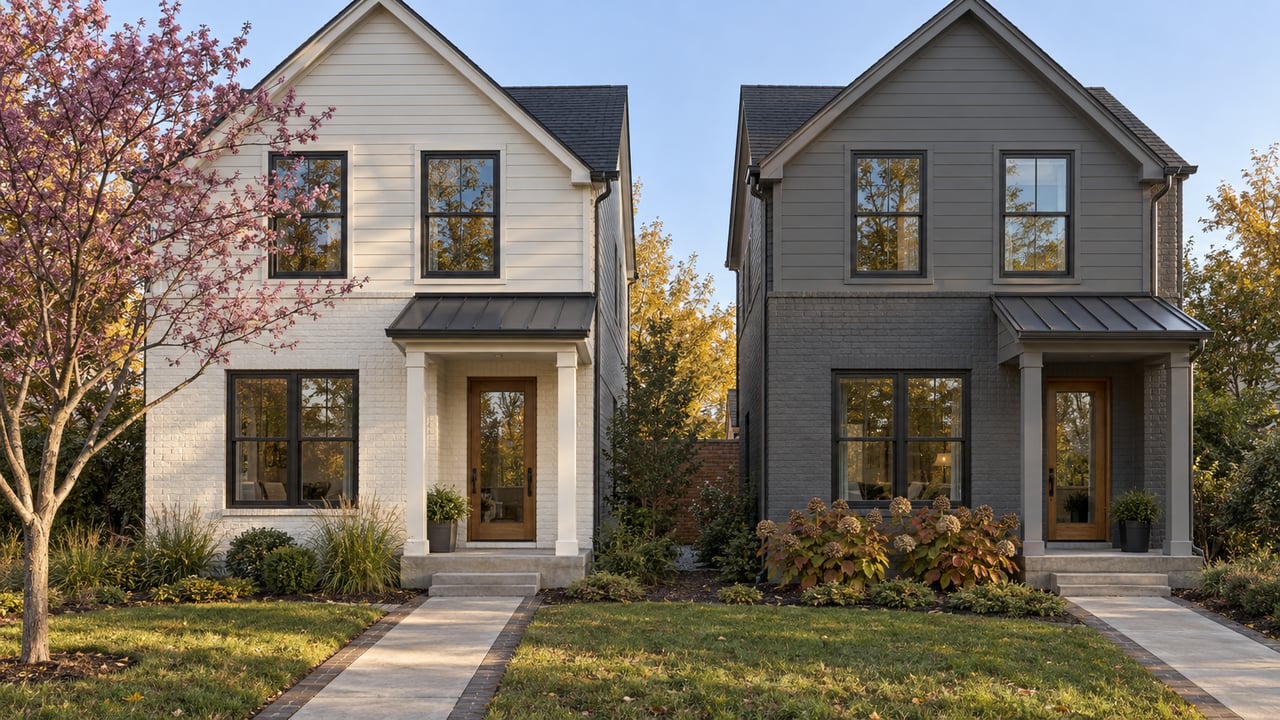
Many of the two-on-one tall-skinny homes in The Nations look like single-family houses in the listing photos but close as condominium units. Since August 2025, most of the neighborhood's residential core has also been zoned so that no new short-term rental permit can attach to them, whether owner-occupied or not. So a buyer is getting a home to live in or lease long term, plus a short set of recorded documents that decide who pays for the driveway, who insures the roof, and what happens when the two owners disagree. In this part of West Nashville, those documents have a bigger effect on long-term value than the countertops do.
The Deed Behind the Shared Driveway
Two-on-one homes in The Nations are usually built under Tennessee's Horizontal Property Act, a 1963 statute that lets one parcel be divided into separately owned units plus shared common elements by recording a master deed. Collins Legal, a Nashville law firm, describes how builders came to use it. Where Metro zoning allowed two dwelling units on a lot but the lot was too small to split into two lots that each met the minimum size, the act let a builder put two detached homes on the one lot and sell them separately. The firm says that leaves the tall-skinny "legally closer to a two-unit condominium than to two ordinary houses."
The master deed and recorded plat have to describe the land, identify each unit, list the general common elements, limited common elements and private elements, and include bylaws for running the regime. Under state law, common elements can include the land, foundations, main walls, roofs, yards and gardens. Whether any of those are actually shared in a given pair of homes depends on what the declaration says. Collins Legal notes that in a two-unit Nashville regime, the common elements are often just a shared driveway and maybe a retaining wall. Some master deeds label nearly everything a private element, which leaves each owner responsible for their own structure.
Three mechanics come up most often in a transaction:
- Governance. The same firm says two-unit bylaws are often skeletal, sometimes a single page. That works until the owners disagree about something the document never covered. With only two owners, a decision that needs a majority can stall completely.
- Shared costs. Common-element expenses are split pro rata. Unpaid assessments can become a lien against the unit, so the allocation and any outstanding balance matter at resale.
- Insurance. Tennessee law lets co-owners insure the building by majority resolution while each owner insures their own unit. After a casualty, proceeds generally go toward rebuilding, and any shortfall is allocated among the affected owners.
Taxes are simpler. Each unit is assessed and taxed as its own parcel, with the value of the common elements allocated among the owners. A finished unit gets its own Davidson County parcel ID, its own mortgage and its own title policy, just like a standalone house. Because each unit has its own parcel ID, the condo structure appears in the recorded master deed, not in the tax record.
Which Loan Programs Treat It as a Condo
Being part of a regime doesn't rule out conventional financing. Under the current Fannie Mae Selling Guide, section B4-2.1-02, dated August 5, 2026, project review is waived for a unit in a two- to four-unit condo project and for any fully detached condo unit. The usual property, appraisal and insurance requirements still apply.
FHA works differently. HUD will insure a unit in an FHA-approved project. It also has a Single-Unit Approval path for projects that aren't approved, but HUD's condominium guidance limits that path to projects with at least five dwelling units.
| Pathway | How a two-unit regime fits | Source |
|---|---|---|
| Fannie Mae conventional | Project review waived for two- to four-unit condo projects and detached units; standard property and insurance rules still apply | Selling Guide B4-2.1-02 |
| FHA project approval | Available if the project goes through HUD approval | HUD |
| FHA Single-Unit Approval | Requires a project of at least five dwelling units, so a two-unit regime falls outside it | HUD |
For a seller, the table shows which buyers can finance the home. For a buyer, it's the reason a lender should see the master deed early in underwriting, not the week before closing.
The Rental Rights the 2025 Rezoning Took Away
Short-term rental eligibility was already limited for these homes before the rezoning. Metro Codes allows only one owner-occupied permit per lot in single- and two-family zoning districts. It also requires both units of a two-family lot to have the same owner, who lives in one of them, and it names "detached duplexes divided under a Horizontal Property Regime (HPR)" specifically. Metro Codes' permit-types page adds that new non-owner-occupied permits aren't allowed in R, RS or RM districts, and existing ones don't transfer when the property sells. So a buyer of one half of a two-on-one was never in a position to get an owner-occupied permit for that half.
The rezoning closed the remaining options for most of the neighborhood. BL2025-830 took effect August 29, 2025. It covers about 329 acres between 43rd and 63rd Avenues North, north of I-40 and south of Centennial Boulevard, with additional parcels north of Centennial. The Planning Commission staff report explains that the new RM40-A-NS district's "-NS designation prohibits Short-Term Rental Property – Owner Occupied and Short-Term Rental Property - Not Owner Occupied uses." It also says both types are banned in all proposed residential zones and some mixed-use zones. The Council's amendment to the bill describes what happens to permits that already exist:
"...the rezoning legislation will also remove the eligibility for properties within the residential portion of the neighborhood to have short term rentals; however, property owners with existing short term rental permits will be able to maintain and renew their permits as allowed by the Metropolitan Code and state law for as long as they own their property"
That's the text of Amendment No. 1 to BL2025-830. The key phrase is "for as long as they own their property." A permit on a Nations two-on-one can keep the seller's rental income going until closing, but it doesn't pass to the buyer. Later approvals have followed the same line. The SP amendment for 5901 California Avenue, which Council passed in July 2026 for up to 296 multifamily units, prohibits both permit types on that site. As of the September 24, 2026 Planning Commission agenda, RM40-A-NS was still listed as the existing zoning at 5608 California Avenue.
Why the Next Generation of Homes Here Looks Different
The same zoning that ended short-term rentals also removed the constraint that made the two-on-one regime the standard workaround. WSMV reported that the plan allows up to 40 housing units per acre. In the Residential Neighborhood area, the Nations Urban Design Overlay sets the minimum lot size at "None" and caps single- and two-family buildings, townhouses and interior-lot stacked flats at 35 feet. Stacked flats on corner lots can go to 45. Collins Legal ties the regime's use to lots that couldn't meet minimum-size rules. Once there's no minimum lot size, that reason goes away on paper, and builders can choose townhouses and stacked flats where they used to pair two homes on one lot. The overlay also leaves base-zone standards it doesn't modify in place, so each parcel's allowed uses still have to be checked individually.
Councilmember Rollin Horton, who introduced the measure, told WSMV that "Change is coming to this neighborhood one way or another, and what this plan does is it allows us to be intentional about what that change looks like." He also said the changes would come gradually and could take years to show.
That leaves a large existing stock of two-on-ones operating under rules written for a different zoning setup. A September 2024 Mercatus Center study estimated that at least 20,125 regime homes were built in Davidson County from 2010 to 2023, about 22% of the county's housing production over that period. It counted 8,675 of them as two-on-one units. The study also found that Metro doesn't track regime production or code these units in its property records. So the authoritative record of how a given pair of homes is structured is the master deed on file with the Davidson County Register of Deeds.
Using a Slower Market to Read the Documents
The regional market leaves room for that review. Greater Nashville REALTORS reported 15,536 active listings across its nine-county region in September 2026, up 6% year over year, with 5.7 months of supply. The average single-family home took 57 days to go under contract. The regional single-family median was $510,000 that month, compared with a condo median of $331,780. For Q3 2026, GNR's county chart puts Davidson County at $520,000 for residential and $340,000 for condominiums. A two-on-one is legally a condo unit, but it's marketed like a house, so price comparisons should start from the recorded documents and the listing photos second.
With those timelines, a buyer can usually collect the following before the inspection period ends:
- The recorded master deed, plat and bylaws, read for how they define common, limited common and private elements.
- Any insurance resolution the co-owners have adopted, and how casualty losses would be split.
- The current common-expense allocation and confirmation that no assessments are unpaid.
- The parcel's current base zoning and any overlay, checked against Metro's parcel viewer.
- If a short-term rental permit exists, written confirmation of who holds it, since under the amendment it stays with the current owner.
Everything here is general information, not legal, tax, lending or insurance advice. Confirm how these rules apply to a specific property with an attorney, lender or insurance professional.
Frequently Asked Questions
Can I buy both halves of a two-on-one and live in one? Metro's general rule allows one owner-occupied permit per lot when one person owns both units and lives in one. On parcels rezoned to RM40-A-NS, though, the staff report says both permit types are prohibited.
Is there always an HOA? Not always a formal one. The bylaws set out meetings, voting, maintenance, insurance and assessments if there's an owners' association, and with two units they're often minimal.
What does the Horizontal Property Act say about dividing shared elements? Collins Legal describes the act as keeping common elements undivided and not subject to a partition action while the regime exists. How that applies to a particular property or disagreement is a question for a Tennessee attorney.
At The Costigan Group, we start a Nations two-on-one purchase by reading the master deed, the parcel zoning and any permit history before an offer goes in. Book a consultation, and we'll go through those documents with you for the specific home you're considering.