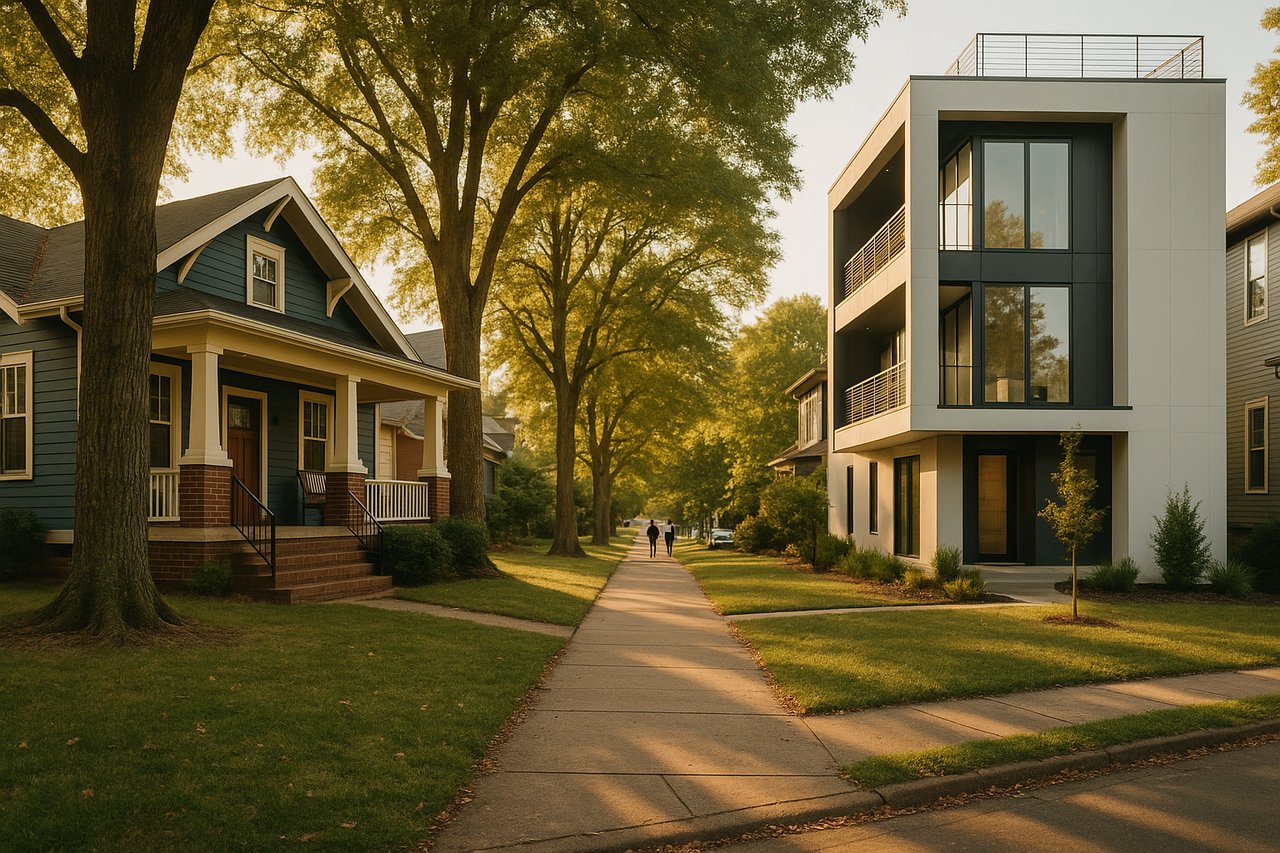
A buyer reaches out wanting to get into East Nashville. They've walked Five Points, loved the bungalows, looked at the broad zip code median, and assumed the neighborhood is one coherent thing with one coherent price point. Two weeks later, they almost overpay for a new construction townhome on a block that the market has been ignoring — while a renovated 1920s Craftsman three streets over trades in under three weeks at full ask. That disconnect is the story of East Nashville real estate in 2026: a neighborhood where the averages lie and the truth lives on the individual block.
What "East Nashville" Actually Means for a Buyer
The phrase covers more ground than most buyers realize. The primary ZIP code is 37206, which covers Five Points, Lockeland Springs, Historic Edgefield, Rosebank, Shelby Hills, and the Barclay Drive area. The northern edge bleeds into 37216, which covers Cleveland Park, Greenwood, and the Inglewood neighborhood. That's two different ZIP codes, multiple distinct neighborhoods, and a price range that runs from entry-level townhomes in the low $300s to fully renovated historic homes well above $1.5 million.
Most buyers searching "East Nashville homes" are actually picturing something specific — the walkable core near Five Points and Lockeland Springs — but often touring something very different because their search radius is too wide. Before the first showing, it's worth being precise about which sub-neighborhood you're actually buying into, because the micro-market dynamics are completely different.
To orient yourself across Greater Nashville's neighborhood options, the Costigan Group neighborhood guide breaks down the key distinctions across Davidson County and Middle Tennessee, including how East Nashville compares to 12 South, Germantown, The Nations, and the suburban counties.
The Current East Nashville Market: What the Numbers Actually Say
In March 2026, East Nashville home prices were down 1.2% compared to last year, selling for a median price of $560K. That top-line number is useful context, but it flattens a market that is doing very different things depending on product type and block.
As of early 2026, the median home value in East Nashville's 37206 ZIP code is $631K — down 3.7% over the past 12 months. The most active price range is $400K–$600K, where smaller Craftsman bungalows and updated cottages trade most frequently. New construction and larger infill homes push well above $700K, with a healthy number of sales over $1M. Price per square foot runs $300–$350 in the entry range and $400–$500+ for new builds.
Here's the more useful framing: resale and new construction are behaving like two different markets inside the same ZIP code. In Q1 2026, 41 new homes closed across zip codes 37206 and 37216, representing 22.3% of all residential sales in the area. These new builds sold at a $899,000 median and $923,000 average, commanding a 53% to 71% premium over resale homes depending on the month. A buyer comparing a $580K resale bungalow and a $900K new infill townhome is not comparing apples to apples — they're comparing entirely different value propositions with entirely different buyer profiles.
On average, homes in East Nashville sell after 89 days on the market — but that figure includes overpriced resale properties that sat for months, brand-new construction that moved quickly, and everything in between. The median days on market in 37206 is currently 62 days — significantly more breathing room than the frenzied 10–20 day market of 2021–2022. Well-priced homes in good condition still move in 2–3 weeks. Overpriced homes or those with deferred maintenance are sitting 90+ days. Condition and pricing discipline matter more than they have in years.
Block-by-Block: The Pocket Guide Every East Nashville Buyer Needs
East Nashville is not one market. It's closer to eight micro-markets stacked next to each other, each with its own price floor, buyer profile, and absorption pace. Here's how we break it down with clients.
Lockeland Springs: The Premium Historic Core
Lockeland Springs is the premier residential neighborhood in East Nashville and one of Nashville's most historically significant communities. Located in the 37206 ZIP code between Shelby Park to the south and the Five Points commercial district to the northwest, Lockeland Springs recorded 41 closed sales over the past 12 months at an $875,000 SFR median, making it the highest-priced neighborhood in the entire East Nashville content cluster.
The 1910s–1920s era dominates at 35.9% of all single-family residential transactions, producing the cottages and bungalows that define the neighborhood's visual identity. These homes typically sit on 50-by-150-foot lots with original hardwood floors, covered porches, and craftsmanship details that draw buyers from across Nashville. As of April 2026, active listings carry an average listing price of $949,750. The highest-priced property listing is $1,449,000, while the lowest priced property starts at $750,000.
This is the pocket that attracts design-aware buyers who are here for the architecture and the long haul. It is also the pocket where pricing pressure is sharpest — there is very little room to buy badly here, because the market will find the overpays quickly.
Historic Edgefield: Downtown-Adjacent and Architecturally Rare
Historic Edgefield was platted in the 1870s, and features Italianate Victorians, Queen Annes, and early 20th century cottages on some of the most beautiful streetscapes in the city. It sits 5–7 minutes from downtown by car. Price floors here have held firm because the product is genuinely irreplaceable — you cannot build a Victorian streetscape from scratch — and the proximity to downtown makes it one of the most compelling lifestyle buys in all of Davidson County. Expect to start around $700K for unrenovated stock and well above $1M for the best-finished homes.
Five Points and Rosebank: Walkability With a Mid-Market Entry
East of Five Points, Rosebank is quieter and more residential. Porter Road runs through it with a strip of businesses that give it neighborhood feel without the weekend crowds. The $400K–$650K range is active here, with smaller bungalows and updated cottages drawing first-time buyers and people relocating from higher-cost coastal markets who want walkability without paying the Lockeland Springs premium.
Inglewood: The Value Play With Real Momentum
In February 2026, Inglewood home prices were up 3.9% compared to last year, selling for a median price of $566K. On average, homes in Inglewood sell after 74 days on the market, down from 86 days last year. That improvement in days-on-market matters — it signals absorption is picking up, not slowing. Unlike other East Nashville neighborhoods, Inglewood isn't known for its historic homes. Instead, it offers an abundance of Nashville new construction homes, though there are still homes from the 1930s and '40s.
The Inglewood border offers the best value plays in the East Nashville ecosystem. Same energy, lower price, same commute. For buyers who want the cultural gravity of East Nashville without the Lockeland Springs price tag, Inglewood is the rational choice — and the data supports it.
Cleveland Park and the 37216 Border: The Most Underpriced Upside Left
Cleveland Park and Greenwood are more affordable, more working-class historically, and now seeing the same gentrification pressure as the rest of East Nashville but on a slight delay. Located just northeast of downtown Nashville, the Cleveland Park neighborhood is home to about 2,200 residents and is considered one of East Nashville's up-and-coming neighborhoods. This is where buyers who missed Inglewood a few years ago are looking now — and where we're seeing some of the most interesting value on a per-square-foot basis.
New Construction Is Reshaping the Market — And Most Buyers Don't Fully Understand How
The East Nashville new construction story is not like Franklin or Brentwood, where national production builders control entire subdivisions. Here, the landscape is defined by infill development. Unlike the suburban new construction market where national production builders control entire neighborhoods, East Nashville's new construction landscape is dominated by infill development: individual lots or small multi-home projects scattered across established neighborhoods. That means the builder, the lot, and the quality of construction vary dramatically from one block to the next. Having an agent who understands which builders deliver quality and which cut corners is not optional in this market.
New construction in East Nashville ranges from $259,900 for entry-level townhomes at Walton Station to over $2.2 million for custom builds near Five Points and Lockeland Springs. The Q1 2026 median was $899,000 and the average was $923,215 across 41 closings. The most common configuration is a 4-bedroom, 3-bathroom home averaging 2,540 square feet at $354 per square foot.
Products like the Lockewood Collection — gated luxury townhomes developed by Movement Property Group — represent the upper tier of attached new construction in the neighborhood: four bedrooms, rooftop decks, two-car garages, and modern interiors within walking distance of Five Points. At the other end, entry-level townhome communities in 37216 offer price points that let buyers get a foothold in the East Nashville market at a fraction of that cost.
The contrarian point most agents won't say out loud: the new construction premium over resale — 53% to 71% depending on the month — is not always justified by long-term value. A well-renovated 1920s Craftsman in Lockeland Springs on a good lot has a ceiling that a new-construction townhome on a tight infill site often cannot match. Buyers drawn to new construction for the turnkey convenience should understand exactly what they're paying for the privilege.
The East Bank Factor: Real Demand Driver, Imprecise Timeline
No conversation about East Nashville real estate is complete without addressing the East Bank. The East Bank is a 550-acre area adjacent to the Cumberland River, running from River North and the planned Oracle campus all the way to I-24 to the south. The size of the project is nearly 10 times the size of Nashville's Gulch neighborhood.
There are still multiple catalysts that haven't hit the market yet: Oracle's hiring ramp — about 900 employees work locally today against a pledge of 8,500 by end of 2031. Most of that hiring hasn't happened yet. When it does, those employees need somewhere to live. Recruitment data indicates these roles offer average technical salaries near $138,000. A dual-income household in this sector commands purchasing power that supports the $750,000 to $1.2 million housing tier. This creates permanent price support for Davidson County, specifically anchoring values in Cleveland Park, McFerrin Park, Highland Heights, and Inglewood.
The East Bank development is real, funded, and in active construction. The $2.2 billion stadium passed a critical construction milestone in late 2025, when a topping-out ceremony celebrated the hoisting of the final piece of the ring beam to the top of the structure. It's expected to be complete in time for the 2027 season. But the timeline for Oracle's full hiring ramp, the pedestrian bridge, and East Bank Boulevard remains multi-year. Buyers should factor the East Bank into their long-term thesis — not into their short-term pricing expectations.
How We Actually Advise East Nashville Buyers
The mistake we see most often is buyers using zip code-level data to make block-level decisions. The East Nashville median does not tell you whether the specific home on the specific street is priced correctly. That requires actual comparable analysis filtered by product type, era of construction, lot size, and proximity to commercial corridors.
Here's the framework we walk every East Nashville buyer through before they write an offer:
- Define the actual pocket first. Lockeland Springs, Historic Edgefield, Rosebank, Inglewood, and Cleveland Park are different markets. Start with your lifestyle priorities — walkability, architecture, lot size, commute — and let that narrow the geography before looking at listings.
- Separate new construction from resale in your comp analysis. Buyers comparing year-over-year averages without separating new construction from resale will draw misleading conclusions about price appreciation. Run the two product types independently.
- Check the flood map before you fall in love. Some properties near the Cumberland River and low-lying areas can sit in FEMA flood zones. Always evaluate parcel-specific risk and potential insurance costs. Insurance costs on a flood-zone property can meaningfully change the monthly payment math.
- Interrogate new construction quality. East Nashville infill varies enormously by builder. A well-built product and a cost-cut product can look similar on a listing sheet and price identically. The difference shows up at the inspection — and in resale value five years later.
If you're relocating to Nashville and East Nashville is on the shortlist, our Nashville relocation advisory covers the full picture: how East Nashville compares to other Davidson County neighborhoods, what the commute looks like from different pockets, and how we help out-of-state buyers make confident decisions without making a dozen trips to town.
If investment is part of your calculus — long-term rental or short-term rental — the East Nashville market has nuance there too. Zoning, Metro permitting rules, and HOA restrictions vary dramatically by product type and block. Our Nashville short-term rental advisory covers how we underwrite properties before an offer is made, not after.
For buyers at the top of the East Nashville market — fully renovated historic homes in Lockeland Springs or Historic Edgefield above $1.2 million — the strategy shifts into luxury seller and buyer territory. Our Nashville luxury real estate practice handles that tier of the market differently, with pre-market access, off-market relationships, and a pricing strategy calibrated to the rarity of the product.
If you're a serious buyer in East Nashville, the right move is to contact us before you start touring. We'll map the market for you by pocket, set realistic price expectations by product type, and make sure you're not paying new construction premiums for a resale outcome — or missing a value pocket because the data averages looked flat.
Frequently Asked Questions: East Nashville Real Estate
What is the median home price in East Nashville in 2026?
In March 2026, East Nashville home prices sold for a median price of $560K, down 1.2% compared to last year. However, that figure masks significant variation: the median home value in East Nashville's 37206 ZIP is $631K, with the most active price range being $400K–$600K, where smaller Craftsman bungalows and updated cottages trade most frequently. New construction runs considerably higher — the Q1 2026 median for new builds was $899,000.
Is Lockeland Springs the most expensive part of East Nashville?
Yes. Lockeland Springs recorded 41 closed sales over the past 12 months at an $875,000 SFR median, making it the highest-priced neighborhood in the East Nashville cluster. Homes in Lockeland Springs typically list for between $700,000 and $2 million, with the premium driven by historic housing stock, lot size, neighborhood organization, and walkability to Five Points. Historic Edgefield competes at similar price levels for different architectural reasons.
How does new construction compare to resale in East Nashville?
In Q1 2026, new builds represented 22.3% of all residential sales across 37206 and 37216, selling at a $899,000 median and $923,000 average — commanding a 53% to 71% premium over resale homes. That premium buys turnkey condition, modern systems, and in some cases specific zoning advantages. What it does not necessarily buy is long-term appreciation equivalent to a well-located historic property on a superior lot. Buyers should underwrite the specific product, not the category.
What is the East Bank development and how does it affect East Nashville home values?
The East Bank is a 550-acre area adjacent to the Cumberland River, running from River North and the planned Oracle campus all the way to I-24 to the south. Oracle's hiring ramp projects about 900 employees locally today against a pledge of 8,500 by end of 2031. The long-term demand tailwind for neighborhoods like Inglewood, Cleveland Park, and McFerrin Park is real — but the hiring ramp is multi-year. East Nashville buyers should treat the East Bank as a structural long-term value driver, not a near-term pricing event that justifies overpaying today.
What should relocating buyers know before purchasing in East Nashville?
The most important thing is that East Nashville is not a single market — it's a collection of distinct micro-neighborhoods with different price floors, architectural character, walkability, and investor profiles. Historic Edgefield and the western edge sit 5–7 minutes from downtown Nashville by car. Five Points and Lockeland Springs run 8–12 minutes depending on traffic. The eastern edges near Shelby Hills and Barclay Drive are 12–18 minutes out. Relocating buyers also need to understand that some properties near the Cumberland carry flood zone exposure that changes insurance costs meaningfully. Work with an advisor who can map these distinctions before you start touring.
Jack Costigan is the founder of The Costigan Group at Compass in Nashville, where his team has closed more than $100 million in real estate across Greater Nashville and Middle Tennessee. Specializing in luxury advisory, investment, and short-term rental real estate, Jack is known for a data-driven approach that helps buyers, sellers, and investors understand the numbers, the neighborhood, and the long-term value before making a decision. Featured in Apple News as one of Nashville's most sought-after short-term rental advisors, Jack pairs deep local expertise with modern marketing and a strategy-first approach to real estate. Learn more at thecostigangroup.com.