Metro Nashville's non-owner-occupied STR permit pool is sitting at roughly 4,800 active units across Davidson County heading into mid-2026 — and that number is not growing in most residential zones. Davidson County's non-owner-occupied STR permit list sits at roughly 4,800 active units, and the Metro Council's Type 2 moratorium in most residential zones means that number is capped, not growing. Inside that fixed pool, two neighborhoods dominate investor conversations: Germantown and East Nashville. They're five minutes apart by car and separated by a river. The investment profiles are far more different than that proximity suggests.
This is not a "both neighborhoods are great" post. It's a breakdown of two genuinely distinct deals — different entry prices, different permit realities, different guest profiles, different exit strategies. If you're trying to decide where to put capital, the distinctions matter more than the zip code overlap.
The Permit Reality Comes First — Always
Before revenue projections, before cap rate math, before you even look at photos: the permit question is the one that determines whether a specific Nashville STR deal is legal or a liability. Most failed Nashville Airbnb investments trace back to a single mistake: assuming a property qualifies for NOOSTR use because comparable nearby properties operate as STRs. Nashville STR eligibility is parcel-specific.
Nashville short-term rentals are governed by Metro Code §6.28 and enforced by the Department of Codes and Building Safety. Metro Codes recognizes two permit types: Owner-Occupied (OOSTR) and Not Owner-Occupied (NOOSTR). The two have meaningfully different eligibility rules, allowed zoning districts, and operational restrictions. For investor-owned STRs — meaning you don't live there — you need a NOOSTR permit.
NOOSTR permits are restricted to 29 zoning districts under the current Metro Code framework, concentrated in commercial-mixed (MUL, MUG, MUI), specific plan (SP) districts where STR use was approved, and certain industrial-residential overlays. Most residential single-family zones (RS, R) do not allow NOOSTR.
Here's where Germantown and East Nashville diverge sharply. Germantown's dominant property type — the purpose-built, three-story townhome — is frequently developed on mixed-use corridors or in specific plan districts that are NOOSTR-eligible. East Nashville's dominant residential fabric — the craftsman bungalow, the renovated Victorian, the infill single-family — sits almost entirely in RS-zoned land. NOOSTR is not available in RS zones. Non-owner-occupied permits are frozen in most residential zones. New permits are issued mostly in commercial and mixed-use zones like SoBro, The Gulch, and parts of East Nashville along Main.
That last phrase matters: parts of East Nashville along Main. There are pockets of mixed-use zoning in East Nashville — certain corridors along Main Street and Gallatin Avenue — where NOOSTR can still be issued or already exists. But they're the exception. An investor who buys a $600,000 craftsman on McFerrin Avenue thinking it qualifies as a non-owner-occupied STR is making an expensive mistake. New NOO permits are not permitted in AR2A, R, RS, or RM zones, which cover the bulk of Nashville's residential land. Existing NOO holders in those zones may renew, but the permit is not transferable if the property is sold or transferred. On sale it is gone for good.
That "gone for good" line is what most out-of-state investors miss when they see an East Nashville listing marketed as a current Airbnb. Permits are annual and non-transferable. They end on sale or any change of ownership entity. You cannot buy someone else's permit. You can only buy a property that can receive a new one.
Germantown: The Purpose-Built Play
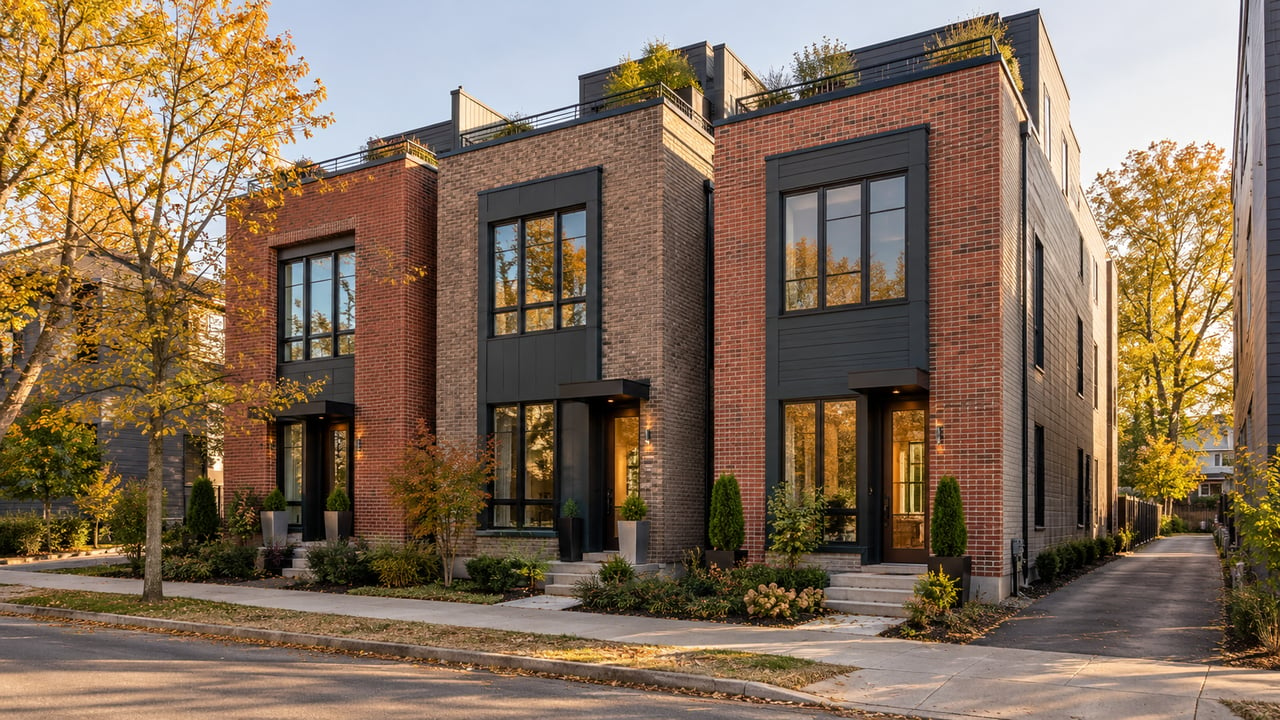
Germantown's transformation from industrial corridor to luxury residential has been one of the cleaner development stories in Nashville. The area combines old-world brick townhomes and renovated Victorians with sleek modern infill and luxury condos. For STR investors, that modern infill is the operative word. The purpose-built townhomes that have proliferated along Monroe, Madison, and the north side of the neighborhood were largely developed in SP (specific plan) or MUL-zoned parcels — which is exactly where NOOSTR permits live.
Entry price for a NOOSTR-eligible Germantown townhome is real money. According to Zillow's Home Value Index updated June 30, 2026, the average Germantown home value is $625,203, up 0.8% over the past year. Purpose-built STR townhomes with three bedrooms and a private rooftop deck commonly list in the $700,000 to $900,000 range. At the upper end, the heart of Germantown's new construction luxury market features developments like Tennyson Germantown at a $1.65M median across 21 sales. Those are not STR investment properties — that's a different buyer entirely.
The investable STR band in Germantown sits roughly between $600,000 and $850,000 for a two- to three-bedroom townhome with the right zoning. At that price point, the math requires disciplined underwriting. Nashville's short-term rental market has 13,898 active listings as of June 2026. The average active listing earned $40.9K in revenue over the trailing twelve months, with listings booked 54% of nights available at an average daily rate of $349. A well-positioned Germantown townhome with a rooftop, a clean design, and three bedrooms can clear $55,000 to $70,000 in gross annual revenue — above the citywide average, because Germantown draws a guest who will pay a downtown premium without staying downtown.
The Germantown guest is not the bachelorette party group. That traffic runs through SoBro, The Gulch, and lower Broadway-adjacent streets. Germantown pulls design-conscious travelers, food-driven couples and small groups, and weekend visitors who want walkable access to one of Nashville's most curated dining corridors — Rolf and Daughters, Butcher & Bee, The 404 Kitchen — without sleeping above a honky-tonk. That guest profile produces higher ADR relative to size and a more consistent occupancy curve outside the bachelorette season peaks.
One caveat on Germantown: competition density is real. The same zoning that makes a property NOOSTR-eligible also allowed every other developer to build STR-eligible inventory on the same block. If your underwriting relies on 65% occupancy and $275/night in a corridor with 40 comparable listings within three blocks, rerun the model at 52% and $230. That's the honest base case in a mature, high-density STR pocket.
East Nashville: The Owner-Operator Equation
East Nashville is one of the most desirable neighborhoods in Middle Tennessee for a reason that has nothing to do with STR investing: people actually want to live there. That residential demand is the most important fact about the East Nashville short term rental market, because it shapes what deals are available and who they work for.
According to Redfin data, the median sale price of a home in East Nashville was $583K, up 5.2% since the prior year. The median sale price per square foot is $330, up 4.8% year-over-year. That's a solid appreciation story. It's also a story about residential demand — not STR demand. The buyers pushing East Nashville prices up are mostly owner-occupants, not investors.
So what does an East Nashville short term rental actually look like? There are two legitimate structures, and only one of them applies to most investors reading this.
The first is the OOSTR path: buy the property, make it your primary residence, and operate as an owner-occupied short-term rental. Owner-occupied rentals are primary residences. The owner lives there. They can rent out rooms or occasionally the entire home. These are still allowed in most residential areas with a few designated no-STR districts. This is a legitimate structure for the right buyer — someone who wants to live in East Nashville, house-hack a portion of it, and offset their mortgage with STR income on the nights they're away or in a separate suite. That is not a pure investment strategy. It's a lifestyle-and-income hybrid.
The second path — pure investor purchase in a mixed-use East Nashville pocket — requires finding a parcel zoned MUL, CS, or a qualifying SP district along a commercial corridor. Those properties exist. They are not abundant. And because they're rare relative to demand, they trade at a premium that compresses the cap rate just as the permit eligibility makes the deal viable. In Nashville, zoning and Type 2 status drive more value than square footage.
For investors who do find legitimate NOOSTR-eligible inventory in East Nashville, the revenue profile differs from Germantown in one meaningful way: the East Nashville guest profile skews toward longer stays, creatives, musicians, and experience-driven visitors who are there for the neighborhood itself — Five Points, Rosemary & Beauty King, the farmers market at East Park, the concert circuit at venues like Eastside Bowl. That guest is not typically booking for one night. Average stays trend longer, which can mean lower ADR but higher occupancy and fewer turnovers. The operational cost structure shifts accordingly. For a deeper look at how we underwrite Nashville STR opportunities before a client makes an offer, see our Nashville short-term rental investment page.
The Price-Per-Revenue Comparison That Actually Matters
Let's put numbers to this. These are directional model scenarios, not guarantees, and every property requires its own underwriting. But the comparison is instructive.
Germantown scenario: A 3-bedroom, 2.5-bath purpose-built STR townhome in a NOOSTR-eligible development, purchased at $775,000. Target gross revenue: $62,000/year (based on $310 ADR at 55% occupancy, conservative against AirDNA's $349 Nashville ADR). After management (20%), platform fees (3%), utilities, insurance, and the annual STR permit fee of approximately $325, net operating income lands around $40,000 to $44,000. At a $775,000 basis, that's a 5.2% to 5.7% cap rate. Not explosive. Not a disaster. A real, holdable investment in an appreciating urban neighborhood.
East Nashville scenario: A 3-bedroom craftsman in a residential RS zone, purchased at $600,000, operating as an owner-occupied STR by a buyer who lives there part-time. This is not underwritable as a traditional cap rate exercise because the owner is in residence. But as a mortgage offset strategy — generating $30,000 to $45,000 in STR income annually while the buyer occupies the property — it can be compelling, particularly given the 2025 tax law, which made 100% bonus depreciation permanent for property acquired after January 19, 2025. Paired with a cost segregation study, an STR buyer can often deduct a large share of the purchase price in year one.
These are two fundamentally different deal structures. Germantown is a traditional rental investment with real cap rate math. East Nashville — in most cases — is a lifestyle-plus-income play that requires owner presence. Conflating them in your underwriting is how you overpay for the wrong property.
Seasonality, Demand Drivers, and the Exit
From June 2025 to June 2026, Nashville STR revenue is down 6.1%, occupancy is up 1.7%, ADR is down 6.0%, and RevPAR is down 9.8% — with active listings also down 1.9%. The market is rationalizing. Rates compressed as supply grew over the 2021–2024 cycle, and some operators who bought at peak assumptions are now holding at breakeven or worse.
The neighborhoods that are holding up best are the ones where demand is structural, not speculative. Recent investor interest in 2025 and into 2026 has increasingly shifted toward locations closer to downtown. As the market matures, proximity to the entertainment district and convention activity is becoming an even more important factor in property performance. Germantown benefits from this — it's close enough to downtown to carry a downtown proximity premium without the operational headaches of full tourist-zone saturation.
East Nashville benefits from a different structural demand driver: it's a neighborhood people move to, not just visit. That long-term residential demand is an excellent exit scenario. A buyer who overpays for an East Nashville STR by $50,000 against comps can potentially absorb that error over a five-year hold if residential appreciation continues. A buyer who overpays for a Germantown townhome based on inflated STR revenue assumptions has fewer legs to stand on if short-term rental income underperforms — because the exit buyer pool is narrower and more investor-dependent.
Both neighborhoods are worth paying attention to for broader Nashville investment context — we cover the full picture across Greater Nashville and Williamson County on our relocation and market overview page for clients evaluating the metro as a whole.
The Decision Framework
Here is how we advise clients who are choosing between these two markets:
- Pure investor, no owner-occupancy, wants maximum STR income: Germantown purpose-built townhome in a verified NOOSTR-eligible SP or MUL zone. Underwrite to $230 ADR and 52% occupancy. Anything above that is upside, not assumption.
- Owner-operator or part-time Nashville resident wanting STR income offset: East Nashville craftsman or newer build on a qualifying mixed-use parcel. The lifestyle premium is real. So is the OOSTR limitation.
- Investor who found an East Nashville property with an existing NOOSTR permit: Read the permit carefully. Ownership changes — including person-to-trust or person-to-LLC conversions — cancel an existing permit. Get zoning confirmation in writing. Build a permit contingency into the contract.
- Anyone who was told by a listing agent that an East Nashville residential single-family qualifies for non-owner-occupied STR: Verify it independently at maps.nashville.gov before the inspection period expires. Do not close on that assumption.
Nashville's STR market has matured past the point where enthusiasm is a substitute for underwriting. The Costigan Group runs pre-offer permit and zoning verification on every STR-targeted acquisition — because we've seen enough clients pay a premium for a deal that didn't survive the Metro Codes check. Whether you're targeting Germantown or East Nashville, that verification step is non-negotiable. If you're ready to run the numbers on a specific property or search for NOOSTR-eligible Nashville STR inventory, that's exactly what we're built for.Related reading
- Nashville Short-Term Rental Investment
- Explore Nashville Neighborhoods
- Nashville STR Underwriting: The Occupancy Assumptions Smart Investors Use
- Nashville STR Permit Guide: What Buyers Must Verify Before Going Under Contract
Frequently Asked Questions
Can I buy a regular East Nashville home and run it as a non-owner-occupied Airbnb?
In most cases, no. The majority of East Nashville's residential land is zoned RS (single-family residential), and new NOO permits are banned in nearly all residential zones. Buildable supply for non-owner-occupied STRs is locked to specific commercial, mixed-use, and downtown zones. You can operate an owner-occupied STR in East Nashville if it's your primary residence, but a pure investor purchase in a standard residential zone will not qualify for a NOOSTR permit. Always verify zoning at the parcel level before making an offer.
Is Germantown actually better than East Nashville for STR returns?
Better isn't the right word — different is. Germantown offers more abundant NOOSTR-eligible inventory in purpose-built townhome developments, which makes it the cleaner pure-investment play. East Nashville trades at a comparable price point but with far more restricted STR eligibility for investors. The most reliable short-term rental investments are properties designed for group travel, as proximity to downtown consistently drives higher revenue, occupancy, and long-term performance. Germantown's proximity to Lower Broadway gives it a structural demand advantage for group guests. East Nashville's advantage is long-term residential appreciation and a guest profile that produces longer average stays.
What happens to a NOOSTR permit when I buy a Nashville STR property?
It does not transfer to you. Permits are annual and non-transferable. They end on sale or any change of ownership entity. This is one of the most consequential facts in Nashville STR investing. If you purchase a property that holds a current NOOSTR permit in a residential zone, you cannot renew or reissue that permit under your ownership. The only safe path is buying a property in a zone where a new NOOSTR permit can be issued to you as the new owner — and confirming that eligibility before you close.
What's a realistic annual revenue figure for a 3-bedroom Germantown STR townhome in 2026?
A well-positioned three-bedroom Germantown townhome with a private rooftop and clean, modern design should underwrite to approximately $55,000 to $65,000 in gross annual revenue in 2026, using a conservative $300 to $330 ADR at 54% to 58% occupancy. According to AirDNA's June 2026 data, the average active Nashville listing earned $40.9K in revenue over the trailing twelve months, with listings booked 54% of available nights at a $349 average daily rate. Top-performing properties in premium locations outperform this average meaningfully. Model to the middle and let execution earn the upside.
Does East Nashville have any NOOSTR-eligible properties at all?
Yes, but they're a small fraction of total East Nashville inventory. New permits are issued in parts of East Nashville along Main and a handful of mixed-use corridors. Properties on or adjacent to Gallatin Avenue, Main Street, or certain commercial nodes in the 37206 zip code may sit in qualifying MUL, CS, or SP districts. These require individual parcel verification — the street address alone tells you nothing. Pull the zoning designation at maps.nashville.gov before drawing any conclusions.
How does Nashville's October peak affect underwriting for these two neighborhoods?
October is the highest-earning month for Nashville STRs with average revenue of $5,084, while January averages just $1,920 — meaning peak months can generate more than 2.5 times the revenue of the off-season. Both Germantown and East Nashville experience this swing, but Germantown's proximity to downtown entertainment and convention activity gives it a more demand-dense event calendar year-round. When underwriting either neighborhood, model monthly rather than annual averages, and stress-test January and February as your worst-case cash flow months.
Is there a tax advantage to buying a Nashville STR in 2026?
Yes, and it's significant. The 2025 tax law made 100% bonus depreciation permanent for property acquired after January 19, 2025. Paired with a cost segregation study, an STR buyer can often deduct a large share of the purchase price in year one. Because short-term rentals with average stays of seven days or less are not treated as passive rental activity when you materially participate, those losses can offset active income — the strategy CPAs call the STR loophole. This is not a substitute for positive cash flow, but it can materially improve the after-tax return on a deal that underperforms in its first year. Run this by a CPA who specializes in real estate, not a generalist.
About The Costigan Group
Jack Costigan is the founder of The Costigan Group at Compass in Nashville, where his team has closed more than $100 million in real estate across Greater Nashville and Middle Tennessee. Specializing in luxury advisory, investment, and short-term rental real estate, Jack is known for a data-driven approach that helps buyers, sellers, and investors understand the numbers, the neighborhood, and the long-term value before making a decision. Featured in Apple News as one of Nashville's most sought-after short-term rental advisors, Jack pairs deep local expertise with modern marketing and a strategy-first approach to real estate. Learn more at thecostigangroup.com.