Redfin's most current data puts the Nashville resale median at $276 per square foot, up 1.8% year over year. On the new construction side, East Nashville's Q1 2026 closings averaged $354 per square foot across 41 transactions, on a typical four-bedroom, three-bath home of roughly 2,540 square feet. That is a 28% premium before you account for a single builder incentive, HOA fee, or STR permit question. Understanding which side of that gap actually pencils for a short-term rental — and why — is the whole decision.
The Two Markets Inside One Metro
Nashville has not had one new construction market for years. It has two, and they behave nothing alike.
The first is suburban production new construction: Nolensville, Mount Juliet, Murfreesboro, Spring Hill, Gallatin. Builders in the outer ring are actively offering rate buydowns, closing cost credits, and upgrade packages to compete for buyers. The National Association of Home Builders found that 61% of builders used sales incentives in May 2026 — the 14th consecutive month at or above 60% — and 32% of builders cut prices, with the average reduction reaching 6%. These are production-built communities priced to move, and the incentives are real. But for STR investors, they are almost entirely irrelevant. The permit environment in most of these zip codes does not support non-owner-occupied short-term rentals, and the tourism demand that fuels Nashville's STR market — Lower Broadway, the convention center, GEODIS Park — does not reach past the Briley Parkway loop.
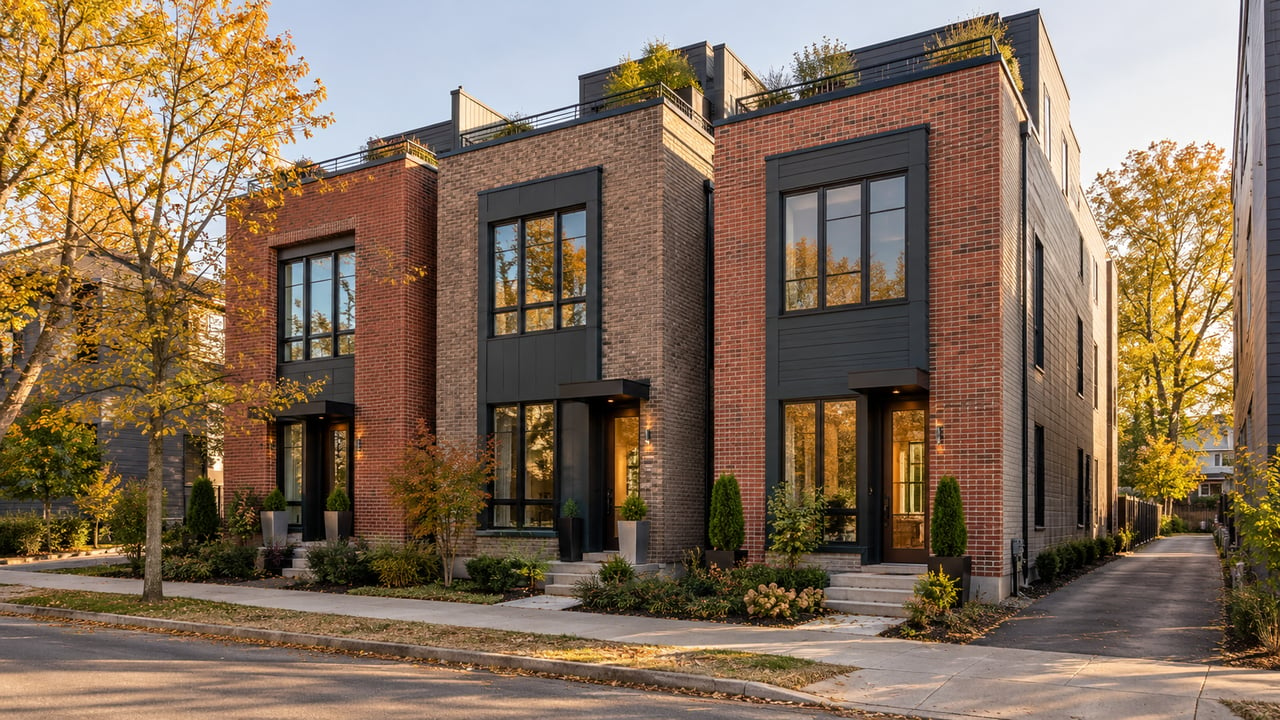
The second is urban infill new construction inside Davidson County: East Nashville, Wedgewood-Houston, Germantown, and corridors close enough to the entertainment district to command STR-grade nightly rates. In Q1 2026, 41 new homes closed in East Nashville's 37206 and 37216 zip codes, representing 22.3% of all residential sales in the area, with new builds selling at a $899,000 median — a 53% to 71% premium over resale homes in the same zip codes. That premium is not irrational. It reflects what the market will pay for a product specifically designed for group stays, rooftop decks, multiple primary suites, and the absence of deferred maintenance. The question is whether STR revenue can justify paying it.
Nashville New Construction at $354/Foot: What You Are Buying
At $354 per foot in East Nashville, a 2,500-square-foot new construction townhome lands around $885,000. The product range stretches from $260,000 entry-level townhomes in gated communities to $2.2 million custom builds on premium lots near Five Points. The sweet spot for STR investors is the $800,000 to $1.2 million band: four bedrooms, three to four baths, rooftop deck, two-car garage, finishes that photograph well. Purpose-built for group travel.
Unlike the suburban new construction market where national production builders control entire neighborhoods, East Nashville's new construction landscape is dominated by infill development — individual lots or small multi-home projects scattered across established neighborhoods, which means the builder, the lot, and the quality of construction vary dramatically from one block to the next. That variability matters for STR underwriting. A poorly located infill build three blocks from a transit corridor earns dramatically less per night than a comparable product on a walkable block near the Five Points intersection.
New construction also carries builder warranties — typically one year on workmanship and longer on structural elements — meaning you are not likely to face a surprise $15,000 HVAC replacement six months after closing. For an STR operator, this is not trivial. A mechanical failure in peak season costs you in emergency repair fees and booking cancellations simultaneously.
Resale at $276/Foot: The Trade-Off Most Buyers Miss
The resale case is not simply "cheaper." It is a different risk profile entirely.
The Nashville resale median sits at $475,000 over the trailing three months through May 2026, with homes averaging 70 days on market — up from 58 days a year ago. More inventory, more negotiating room, and sellers who have been sitting long enough to get realistic. Nashville buyers in 2026 are in a better position than at any point since 2019, with more inventory to choose from, more negotiating leverage in most price bands, and builders offering meaningful incentives — all of which applies on the resale side too.
For STR purposes, the resale advantage is specific: location and permit status that have already been established. Metro Nashville's council voted to prohibit new non-owner-occupied STR permits in R and RS zoned neighborhoods, which means you cannot simply buy any house and convert it to an Airbnb. A resale property that already carries a transferable non-owner-occupied permit in a permissioned zone is worth a documented premium over a new construction property that still needs to navigate the permit process. Buyers underwrite established STR properties as cash-flowing assets, which means documented historical revenue, current bookings calendar, and permit transfer status materially affect the price a serious investor will pay — and the difference between selling at "residential property with STR potential" pricing and "performing STR business" pricing is documentation.
The risk on the resale side is maintenance and capital expenditure timing. A 2018 East Nashville flip at $275 per foot looks cheap until year three, when the HVAC, the roof, and the hot water heaters all need attention. In an STR context, those costs arrive while guests are booking. Build them into the pro forma at acquisition, not after the fact.
What the Spread Actually Signals for STR Revenue
Here is the number that ties this together. According to AirDNA data from June 2026, the Nashville STR market averages $349 per night and 54% occupancy, with strong four-bedroom homes near downtown grossing $80,000 to $160,000+ per year and average listings earning near $40,000. The spread in that range — $40K at the bottom to $160K at the top — is four times, driven almost entirely by proximity to Lower Broadway and product quality, not by whether the property was new construction or resale.
That is the signal. Walkability to Broadway is the single strongest driver of nightly rate. A $900,000 new construction townhome in Germantown that walks to the district in 15 minutes will outperform a $700,000 resale property in a neighborhood with no STR foot traffic, regardless of how well either property photographs. The per-foot premium on new construction in the urban core is worth paying if and only if the location produces the revenue to service it. If it does not, you have paid 28% more for a warranty and modern finishes. That is not an investment thesis.
Nashville's 4,158 active Airbnb listings show an average daily rate of $217 and seasonalized annual revenue of $48,559, against property values averaging $758,548 — meaning investors need to underwrite carefully. Occupancy sits at 32% citywide, above the Tennessee state average of 29%, signaling that Nashville's demand engine remains durable. A 32% citywide average, however, masks massive dispersion. Properties within walking distance of the entertainment district run 50%+ occupancy. Properties in suburban zip codes with no STR zoning path serve a different demand base entirely and should not be underwritten against Nashville's headline numbers.
If you are evaluating a Nashville new construction STR, the right comparison is not citywide averages. It is the specific block, the permit zone, and the documented revenue from comparable active listings within a quarter mile. Our Nashville STR underwriting framework runs that analysis before an offer is written, not after closing.
Purpose-Built vs. Adapted: A Third Distinction
Within new construction, there is one more division worth making: purpose-built STR product versus standard residential new construction that happens to sit in a permissioned zone.
Developers began designing projects specifically intended for short-term rental use rather than adapting traditional residential product, with early examples including Lyric at Cleveland Park, Monty, and Scovel Row — communities that introduced features including larger guest counts, rooftop gathering space, and layouts better suited to group stays. Recent investor interest in 2025 and into 2026 has increasingly shifted toward locations closer to downtown as the market has learned that proximity to the Lower Broadway entertainment district is what separates top-performing STR product from average.
As of May 2026, five buildings represent the recently-delivered new construction category: Hyve, Pullman at Gulch Union, The Emory at Nashville Yards, Athena at the Park, and The Manning. Not all of them permit STR use. Pullman at Gulch Union's HOA bylaws specifically prohibit short-term rental , which means buying a unit there for STR purposes is not viable regardless of what the zoning says. This is a due diligence step that needs to happen before the offer, not during inspection. For a full view of what's currently STR-eligible, the Nashville neighborhoods guide covers zoning context by corridor.
Purpose-built STR new construction at $760 per foot in a condo format (as seen at 635 7th Avenue South in Pie Town) targets a different buyer than the $354-per-foot infill townhome in East Nashville. The condo format delivers STR-optimized amenities and common spaces, but the per-foot entry is twice the urban infill number. The revenue at the top end of that range needs to be $120,000 to $160,000+ annually to make the math work at those acquisition costs. Achievable on the right property in the right block. Not achievable on an average listing.
The Bonus Depreciation Variable
There is one element of this comparison that flips decidedly toward new construction for investor buyers. The One Big Beautiful Bill Act, signed in July 2025, permanently restored 100% bonus depreciation for qualifying property. Paired with a cost segregation study, an STR buyer can often deduct a large share of the purchase price in year one — and because short-term rentals with average stays of seven days or less are not treated as passive rental activity when you materially participate, those losses can offset active income. On a $900,000 acquisition, segregating 20 to 30% into 5-, 7-, and 15-year property can generate a first-year deduction in the low-to-mid six figures for a materially participating owner.
New construction often produces a cleaner cost segregation study than resale because the component costs — mechanical, electrical, finishes, structural — are documented from day one. On a resale property, segregation requires more forensic work and sometimes produces less favorable results. This is not a reason to overpay for new construction on a bad location, but it is a real advantage when two properties are otherwise comparable. Confirm the strategy with a CPA who works specifically with STR investors before making acquisition decisions based on tax treatment.
For investors relocating capital into Nashville from other markets, the combination of no state income tax and the permanent bonus depreciation window is a significant part of the Nashville investment thesis. The Nashville relocation advisory at The Costigan Group covers how out-of-state buyers approach this comparison.
How to Read the Gap Before You Offer
The $78-per-foot spread between East Nashville new construction and Nashville's resale median is not inherently good or bad. It is data. What it tells you depends entirely on three variables: location within the permit zone, product quality relative to comparable active STRs, and the realistic revenue range the property can produce.
The Nashville STR market has transitioned into a measured rebound phase following the 2025 correction, with supply contracting 1.1% year-over-year and aggregate average daily rates climbing to $209, meaning professional operators are regaining pricing leverage. That rebound favors well-located, well-managed product — and both new construction and seasoned resale can qualify, provided the underwriting is honest.
A new construction townhome at $900,000 in Germantown with a confirmed non-owner-occupied permit, a documented comp set showing $95,000 in annual revenue, and a year-one depreciation strategy is a fundable investment. A new construction townhome at $900,000 in a suburban corridor with no STR permit path and $42,000 in revenue comps is a residential purchase dressed up as an investment. The price per foot is identical. The outcome is not.
Before writing an offer on any Nashville STR — new construction or resale — verify the zoning, pull the permit eligibility, run the revenue comparison against active comps, and stress-test the cash flow at 50% occupancy, not 70%. That is how we advise every investor client, whether they're buying a $600,000 infill townhome in East Nashville or a $1.4 million purpose-built unit in SoBro. See the full advisory framework on the Costigan Group STR investment page, or reach out directly to run the numbers on a specific property you are evaluating.
Related reading
- Nashville Short-Term Rental Investment
- Nashville Luxury Real Estate
- Nashville STR Underwriting: The Occupancy Assumptions Smart Investors Use
- Nashville STR Permit Guide: What Buyers Must Verify Before Going Under Contract
Frequently Asked Questions
Is Nashville new construction actually more expensive per square foot than resale right now?
Yes, in the urban infill markets that matter for STR investors. East Nashville new construction averaged $354 per square foot in Q1 2026 and commands a 53% to 71% premium over resale homes in the same zip codes. The Nashville-wide resale median sits at $276 per square foot as of mid-2026. The gap narrows in suburban markets where builders are offering incentives, but suburban new construction is largely irrelevant to STR investors because of permit restrictions.
Can I get a non-owner-occupied STR permit on a new construction property in Nashville?
Metro Nashville prohibits new non-owner-occupied STR permits in R and RS zoned residential areas, which means you cannot simply buy any new construction home and operate it as an Airbnb. Non-owner-occupied permits are now primarily available in commercially zoned corridors. Purpose-built STR communities are specifically developed within these zones. Permit eligibility must be verified at the parcel level before any offer is written — zoning alone does not guarantee a permit, and HOA bylaws can prohibit STR use even in eligible zones.
Do builder incentives on Nashville new construction actually reduce the effective price per foot?
They can, meaningfully. 61% of builders used incentives in May 2026, with 32% cutting prices by an average of 6%; rate buydowns, closing cost credits, and upgrade packages can change a buyer's monthly payment or cash to close even when the advertised price stays the same. Builders are often reluctant to lower base prices because it affects appraisals in the community , which means the "list price" stays high while the effective cost comes down through financing incentives. Compare total effective cost, not just list price, when evaluating new construction against a resale alternative.
What is the STR revenue range for well-located new construction in Nashville versus an average resale listing?
According to AirDNA data from June 2026, strong four-bedroom homes near downtown Nashville gross $80,000 to $160,000+ per year, while average listings earn near $40,000. New construction purpose-built for group stays — multiple primary suites, rooftop deck, high-capacity layout — tends to cluster toward the top of that range when properly located and managed. Resale properties can reach the same range if the location is right and the product competes with modern inventory. Location drives the gap more than whether the property is new or resale.
How does the new construction premium affect STR cash-on-cash returns compared to resale?
Paying 28% more per foot compresses your cash-on-cash return unless revenue scales proportionally. A $900,000 new construction STR generating $95,000 in gross revenue with 25% to 35% operating costs produces a different return profile than a $680,000 resale property generating the same gross revenue. The new construction advantage comes through lower maintenance costs in years one through five, cleaner cost segregation for bonus depreciation, and potentially stronger guest reviews that drive occupancy — but none of those advantages offset a bad location or a property that cannot achieve STR-grade revenue. Nashville's average property values of $758,548 require careful underwriting before any STR acquisition decision.
Are purpose-built STR condos in Nashville a better investment than infill townhomes?
They serve different capital profiles. Purpose-built STR condos in SoBro or Pie Town deliver STR-optimized layouts and amenities with confirmed permit eligibility, but they enter at a significantly higher price per foot — in some cases above $750 per foot — requiring revenue in the $120,000 to $160,000+ range to produce acceptable returns. Infill townhomes in East Nashville or Wedgewood-Houston enter at $354 to $450 per foot, produce competitive revenue if properly located, and offer more flexibility in ownership structure. The right answer depends on your equity position, financing structure, and tax strategy, not on which product type is generically better.
What should I verify before buying Nashville new construction as an STR investment?
Five things, in order: (1) Parcel-level STR permit eligibility — zoning plus Metro permit availability, not assumptions based on neighborhood. (2) HOA bylaws — many new construction communities in otherwise eligible zones prohibit short-term rental entirely. (3) Revenue comps from active STRs within a quarter mile, not citywide averages. (4) Builder incentive structure versus effective cost — understand what you are actually paying after credits and buydowns. (5) Cost segregation feasibility — confirm with a CPA before closing whether the property qualifies for bonus depreciation under your ownership structure and material participation level. Skipping any of these steps is where investors lose money on Nashville new construction deals that look right on the surface. The Costigan Group's STR advisory work covers all five before an offer is submitted.
About The Costigan Group
Jack Costigan is the founder of The Costigan Group at Compass in Nashville, where his team has closed more than $100 million in real estate across Greater Nashville and Middle Tennessee. Specializing in luxury advisory, investment, and short-term rental real estate, Jack is known for a data-driven approach that helps buyers, sellers, and investors understand the numbers, the neighborhood, and the long-term value before making a decision. Featured in Apple News as one of Nashville's most sought-after short-term rental advisors, Jack pairs deep local expertise with modern marketing and a strategy-first approach to real estate. Learn more at thecostigangroup.com.