Most relocating buyers arrive in Middle Tennessee having already built a preference in their head — usually based on a friend's recommendation or a neighborhood they scrolled past on Zillow at midnight. That preference is fine as a starting point. It is not a framework. And without a framework, buyers end up either overpaying for proximity they don't need or trading it away for savings they don't actually capture.
The Franklin vs Brentwood question is the one we field most often with out-of-state buyers relocating to Nashville. Nashville itself gets added to the conversation when the budget allows or when the lifestyle fit is genuinely different. Each of the three markets serves a distinct buyer profile. The goal here is to resolve which profile is yours — in the order the decisions actually need to be made.
Step One: Establish the Real Budget Ceiling, Not the Aspirational One
Before anything else, the market spread matters. As of mid-2026, Nashville (Davidson County) has been selling at a median price of $475,000 — and that number covers everything from East Nashville bungalows to Green Hills renovations. Brentwood closed 461 homes over the trailing six months at a median price of $1,320,000, while Franklin's comparable median came in at $949,995 — both Williamson County markets trading at nearly identical price per square foot of roughly $345 to $346.
That last detail is the one most buyers miss. Both towns sit at similar price-per-square-foot levels in the $330 to $370 range for typical homes, so much of Brentwood's higher median comes from larger homes on larger lots rather than a higher unit price. You are not paying a Brentwood premium for prestige alone — you are paying for acreage. Minimum lot zoning in Brentwood is 1 acre across most of the city, which mechanically floors the entry price and eliminates density.
The practical threshold: if your all-in budget is below $900,000, Brentwood shrinks your options materially. If you are at $1.1M to $1.4M, all three markets are genuinely in play. Above $1.5M, you are buying into Brentwood's core or Franklin's estate product — and Nashville only competes at that number in specific pockets like Belle Meade and Forest Hills.
One financing note worth flagging: the 2026 conforming loan limit is $832,750, which covers the large majority of Nashville (Davidson County) purchases with conventional financing. Williamson County buyers are more likely to push into jumbo territory because prices in Franklin, Brentwood, and Nolensville regularly exceed that threshold. If your lender hasn't mentioned jumbo underwriting yet, ask. Jumbo carries different qualification standards and slightly different rate structures than conforming.
Step Two: Answer the Commute Question Honestly
This is the one buyers rationalize most. "I'll be remote most of the time" is a phrase we hear every week. Then the buyer moves to Franklin, their employer announces three days in-office, and they are suddenly staring at a 45-minute rush-hour commute on I-65.
Here are the numbers as they actually behave. Brentwood sits roughly 10 to 12 miles from downtown Nashville via I-65 or US-31, while Franklin is roughly 20 to 22 miles. In real drive time terms: Brentwood averages 20 to 30 minutes to downtown, with 15 to 20 minutes in light traffic and up to 45 to 60 minutes in peak hours. Franklin runs about 23 to 28 minutes without traffic, and 45 to 60 minutes in rush hour. On a bad Tuesday morning, the two markets feel essentially identical. On a good Thursday mid-morning, Brentwood wins by 10 minutes.
On I-65 South specifically, commutes can easily stretch to 45 to 60 minutes during morning and evening rush hours — the corridor becomes a parking lot during peak times. If your office is downtown and you are going five days a week, Brentwood is the defensible choice. If you are genuinely remote or your office is in Cool Springs or Maryland Farms — both of which sit between the two cities — Franklin's distance penalty drops to nearly zero.
Nashville-proper eliminates the commute equation entirely, which is exactly why urban buyers who work in Midtown, The Gulch, or SoBro consistently choose Davidson County over the suburbs even at equivalent price points. You buy 20 minutes back into your day, every day.
Step Three: Decide Whether School Zoning Is a Price Driver or a Background Factor
Williamson County public schools post an average math proficiency score of 67% versus Tennessee's statewide average of 34%, with schools in the district averaging a 10/10 ranking — placing them in the top 1% of Tennessee public schools. That's not marketing copy; that's state test data.
The important nuance: both Franklin and Brentwood draw from the same Williamson County Schools district. School zone depends on the specific address, not which city you pick. At the high school level, Brentwood High School is ranked fifth in Tennessee, Ravenwood High School ranks ninth, and Franklin High School ranks tenth. Those rankings are tight enough that the individual school zoning of a specific address matters more than the city name on the listing.
Always verify the zone before going under contract — not after. A home on one side of a neighborhood boundary can feed a different high school than the home two streets over. This is one of the steps we run as standard pre-offer process for every buyer we work with in Williamson County.
For buyers choosing Nashville-proper, Davidson County Metro Schools serve the city, and performance varies considerably by zone. Families who prioritize this factor and are looking at Davidson County should research their specific target neighborhoods carefully, zone by zone, rather than relying on county-level averages. Zoning information is available through Metro Nashville Public Schools directly.
Step Four: Match the Lifestyle Profile, Not Just the Price
This is where the three markets genuinely diverge — and where the wrong choice produces the most buyer regret.
Nashville (Davidson County) is for the buyer who wants density, walkability, and optionality. East Nashville, 12 South, The Nations, Germantown — these neighborhoods have restaurants, coffee shops, and weekend energy that Franklin and Brentwood simply do not replicate. The trade-off is lot size, privacy, and public school zoning. A $700,000 budget buys a lot more house in Williamson County than it does in 12 South.
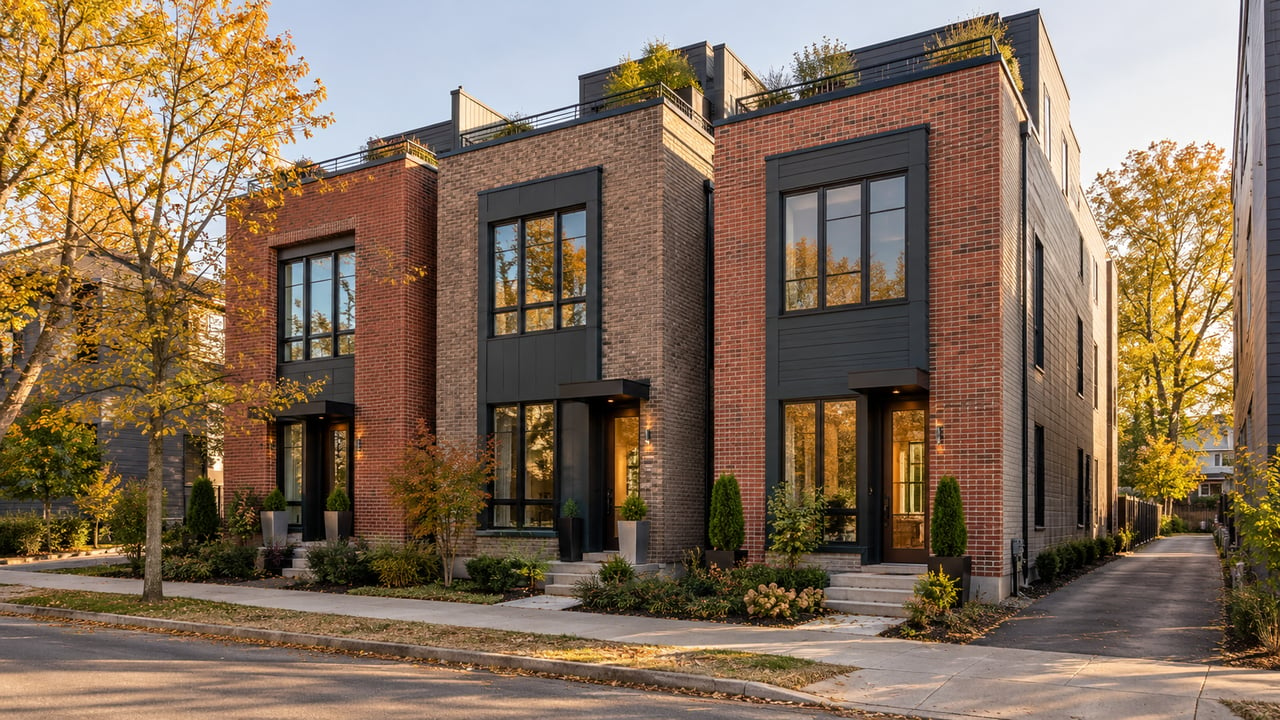
Brentwood is for the buyer who has crossed suburban living off the "compromise" list and genuinely wants it. Brentwood reads as a polished, residential suburb with tree-lined streets and a quieter, low-density feel, with major green spaces like Crockett Park and Marcella Vivrette Smith Park and quick access to retail and services in Cool Springs and the Maryland Farms office area. There is no walkable downtown. That is intentional. Buyers who thrive here are not missing the downtown scene — they have already decided they don't need it.
Franklin occupies the middle. Franklin offers more lifestyle variety: walkable Historic Downtown, master-planned resort communities like Westhaven and Berry Farms, and the adjacent Leiper's Fork rural estate market. The buyer drawn to Franklin typically wants the suburban floor plan with a downtown they can actually walk to on a Saturday morning. It is also the market with the widest inventory range — Franklin offers a wider entry-to-mid range and more inventory than Brentwood, which gives more negotiating room at most price points.
Step Five: Run the Tax Math Before You Lock In a Budget
This is the step that surprises the most out-of-state buyers, particularly those coming from high-tax states where they assume every suburb works the same way.
Davidson County's combined tax rate is approximately $3.254 per $100 of assessed value. Williamson County's rate is lower — approximately $1.73 per $100 of assessed value. Tennessee assesses residential property at 25% of market value, so the effective rate on a $1.3 million Brentwood home works out to roughly $5,623 per year using the Williamson rate. That same home valued at $1.3 million in Davidson County would produce a bill closer to $10,578. Real money, in either direction.
The counterintuitive result: Williamson County communities like Franklin and Brentwood attract buyers despite higher home prices partly because the annual tax burden is structurally lower than Davidson County at comparable assessed values. Buyers relocating from California, New York, or Illinois should note that even Davidson County's higher rate is significantly lower than Harris County, Texas at roughly 2.1 to 2.5%, Cook County, Illinois at roughly 1.8 to 2.2%, or the U.S. national average of approximately 1.07%.
This is the kind of calculation worth running before you fall in love with a specific address. A $50,000 price difference between a Davidson County home and a Williamson County home at the same size could close entirely — or reverse — when you factor in the annual tax delta over a 10-year hold.
The Three Buyer Profiles, Resolved
Profile 1: The urban transplant. Coming from a major city, currently remote or working in Midtown/SoBro/The Gulch, budget under $800,000, no school-age children yet. Nashville-proper wins. Buy in East Nashville, 12 South, or The Nations and keep the lifestyle you actually want. Don't move to Franklin and spend three years wishing you had a corner bar you could walk to.
Profile 2: The family-first relocator. School zoning is a real priority, two incomes, budget in the $800,000 to $1.4 million range, commuting at least three days per week to somewhere in the Nashville metro. Franklin is the natural fit — strong schools, more inventory choices, and the Williamson County tax advantage without Brentwood's price floor. Get specific about which Franklin neighborhood feeds which school before you start touring.
Profile 3: The executive buyer. Budget $1.4 million and above, career that likely involves airport proximity or a Cool Springs office, done with urban density, wants the largest lot and the most established address. Brentwood is where this buyer should be. Single-family Brentwood is currently sitting at about 11.6 months of supply as of July 2026 — a buyer's market — which means negotiating room exists on Brentwood properties in a way it did not two years ago.
If you are not cleanly in one of those three profiles, get precise about the one variable that matters most to you — commute, lot size, schools, or walkability — and let that answer tell you which market wins. Every buyer who comes to us with a genuine priority ends up with a clear answer. The buyers who stay stuck are the ones still treating everything as equally negotiable.
The Nashville Relocation page has more on how we structure the search process for out-of-state buyers, including what to expect on a discovery trip and how we help clients evaluate multiple markets in two days. If you want a framework applied to your specific budget and situation before you fly in, reach out through the main site and we will run the numbers first.
One last note: the full Nashville neighborhood guide breaks down the Davidson County markets — East Nashville, 12 South, Germantown, Green Hills — for buyers who want to go deeper on the urban side before making the Davidson versus Williamson call. And for buyers considering a Brentwood or Franklin home that could also function as a short-term or mid-term rental during a transition period, that is a separate viability check we run at the property level before any offer.
Related reading
- Nashville Relocation Services
- Explore Nashville Neighborhoods
- Nashville Neighborhoods: The Complete 2026 Guide to Where to Buy, Invest, and Live
Frequently Asked Questions
Is Brentwood or Franklin cheaper for the same square footage?
Both Brentwood and Franklin trade at nearly identical price per square foot — approximately $346 versus $345 — but Brentwood's higher median is driven by larger homes on larger lots and closer proximity to Nashville. For the same square footage, expect to pay roughly the same rate in either market. The difference shows up in what comes with the house: Brentwood's minimum lot zoning keeps prices high by eliminating smaller-lot product from the inventory entirely.
Do Brentwood and Franklin use the same school district?
Yes. For the 2026 school year, Williamson County School District serves 52 public schools, with an average testing ranking of 10/10 — placing the district in the top 1% of public schools in Tennessee. However, which specific school a given property feeds depends on its exact address, not the city name. Verify zone assignments through Williamson County Schools before making an offer, not after.
Is now a good time to negotiate on a Brentwood home?
In early 2026, 74% of single-family homes in Brentwood sold below asking price, average days on market increased 11%, and list-to-contract time grew to 88 days. That is more negotiating room than buyers have had in years at this price point. Well-priced, move-in-ready properties still move faster, but the market is no longer punishing buyers who ask for concessions.
Why would someone choose Nashville-proper over Franklin or Brentwood at the same budget?
Walkability, urban density, and commute proximity are the three reasons. A buyer working in Midtown or The Gulch saves 20 to 40 minutes of daily drive time by living in Davidson County. At the same budget, Nashville-proper offers smaller lots and older housing stock in most neighborhoods — but for the buyer who values time and lifestyle over square footage, that trade is worth it. The tax rate is higher in Davidson County, so run the annual cost comparison before deciding the prices are equivalent.
What does a $1.2 million budget actually buy in each market?
In Nashville-proper, $1.2 million puts you in the upper tier of Green Hills, a renovated home in Sylvan Park, or select East Nashville properties with significant square footage. In Franklin, that budget opens up communities like Westhaven and Berry Farms with newer construction and 4 to 5 bedrooms. In Brentwood, $1.2 million is near the market median — you are buying into the core market, not the top, with established subdivisions and 1-acre-plus lots. The tax difference between Davidson and Williamson at this price point is roughly $4,000 to $5,000 per year in Williamson County's favor.
How much does the I-65 construction affect Franklin and Brentwood commutes right now?
Ongoing I-65 improvements, including widening and interchange updates near Franklin and Brentwood, are aimed at improving long-term flow — but they create temporary delays during construction seasons. If you are relocating now, test-drive your actual commute route at your normal departure time on a weekday before going under contract. Don't rely on off-peak Google Maps estimates. The corridor performs very differently at 7:30 AM than it does at 10:00 AM.
Can a relocating buyer compete in these markets sight-unseen?
Yes, but it requires more preparation than it did in 2021. The pace has normalized enough that most buyers have time to do a proper discovery trip. As of July 2026, Brentwood homes were averaging 18 to 25 days on market and Franklin homes 22 to 30 days — not the two-day bidding wars of the pandemic cycle. A well-structured remote offer with correct comparables, a pre-approval from a lender familiar with the market, and clear contingency language is competitive. Sight-unseen offers without local representation typically get the pricing wrong in one direction or the other.
About The Costigan Group
Jack Costigan is the founder of The Costigan Group at Compass in Nashville, where his team has closed more than $100 million in real estate across Greater Nashville and Middle Tennessee. Specializing in luxury advisory, investment, and short-term rental real estate, Jack is known for a data-driven approach that helps buyers, sellers, and investors understand the numbers, the neighborhood, and the long-term value before making a decision. Featured in Apple News as one of Nashville's most sought-after short-term rental advisors, Jack pairs deep local expertise with modern marketing and a strategy-first approach to real estate. Learn more at thecostigangroup.com.